Blog

  • 7 Powerful Benefits of a Supply Chain Audit: Uncover Hidden Costs

    7 Powerful Benefits of a Supply Chain Audit: Uncover Hidden Costs

    Learn what a supply chain audit covers, how it identifies hidden costs, and how Audex helps businesses improve cost control, compliance and efficiency.

    Discover how a supply chain audit helps businesses identify hidden costs, uncover operational gaps, strengthen compliance and improve supply chain efficiency.

    Introduction

    A supply chain audit involves much more than moving products from suppliers to customers. It includes procurement, transportation, warehousing, inventory management, contracts, billing, documentation and coordination between multiple business partners.

    When these activities are not properly monitored, businesses can experience unnecessary expenditure, operational inefficiencies, billing discrepancies and compliance gaps without immediately recognising their underlying causes.

    For example, a company may negotiate competitive transportation rates but still incur avoidable costs because of incorrect freight charges, inefficient warehouse processes, inventory discrepancies or contract terms that are not consistently followed. Individually, these issues may appear minor. Across multiple shipments, warehouses, suppliers and business locations, however, they can create significant financial and operational challenges.

    This is where a supply chain audit becomes valuable.

    A supply chain audit provides a structured examination of supply chain processes, financial transactions, operational controls and contractual arrangements. It helps businesses understand whether their supply chain activities are operating as intended, whether costs are supported by accurate records and where improvements may be required.

    Rather than focusing only on the amount a business spends, an audit examines the reasons behind that expenditure.

    For organisations managing complex supply chains, this approach can reveal hidden cost leakages, strengthen operational control and support better decision-making.

    In this article, we explore what a supply chain audit involves, why it matters, the common cost leakages businesses should watch for, and how Audex helps organisations evaluate their supply chain operations.

    What Is a Supply Chain Audit?
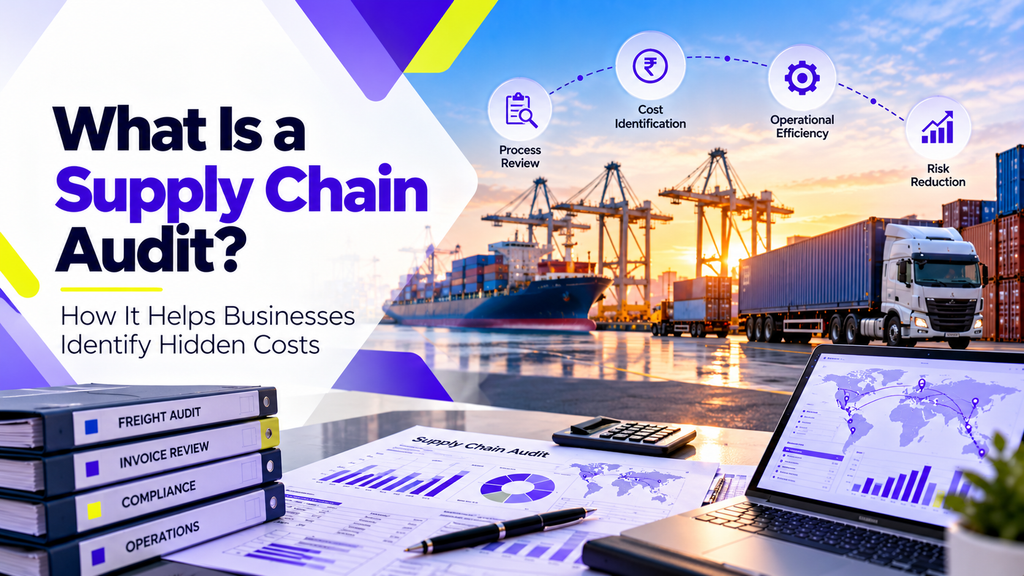
    A supply chain audit is a systematic review of the processes, transactions, contracts, controls and operational activities involved in moving goods and managing supply chain resources.

    Its purpose is to evaluate whether supply chain activities are operating efficiently, whether contractual and procedural requirements are being followed, and whether business expenditure is accurate, justified and properly controlled.

    Unlike a review that focuses on a single invoice or department, a supply chain audit can examine the relationships between procurement, transportation, warehousing, inventory, suppliers, service providers and financial records.

    Depending on the scope of the engagement, a supply chain audit may include:

    • Freight and transportation cost verification
    • Logistics operations and process reviews
    • Contract and rate compliance checks
    • Customs and trade compliance reviews
    • Inventory and warehouse control assessments
    • Supplier and service-provider performance evaluation
    • Billing accuracy and transaction validation
    • Identification of operational inefficiencies
    • Review of internal controls and supporting documentation
    • Recommendations for process improvement

    The exact scope depends on the organisation’s operations, business objectives, available records and identified risks.

    For example, a manufacturer may require a review of transportation expenditure and warehouse processes, while an importer may need closer examination of customs documentation, freight charges and contractual terms.

    The objective is to build a clearer picture of how supply chain activities perform and identify practical opportunities to improve cost control, compliance and operational efficiency.

    Why Is a Supply Chain Audit Important for Businesses?
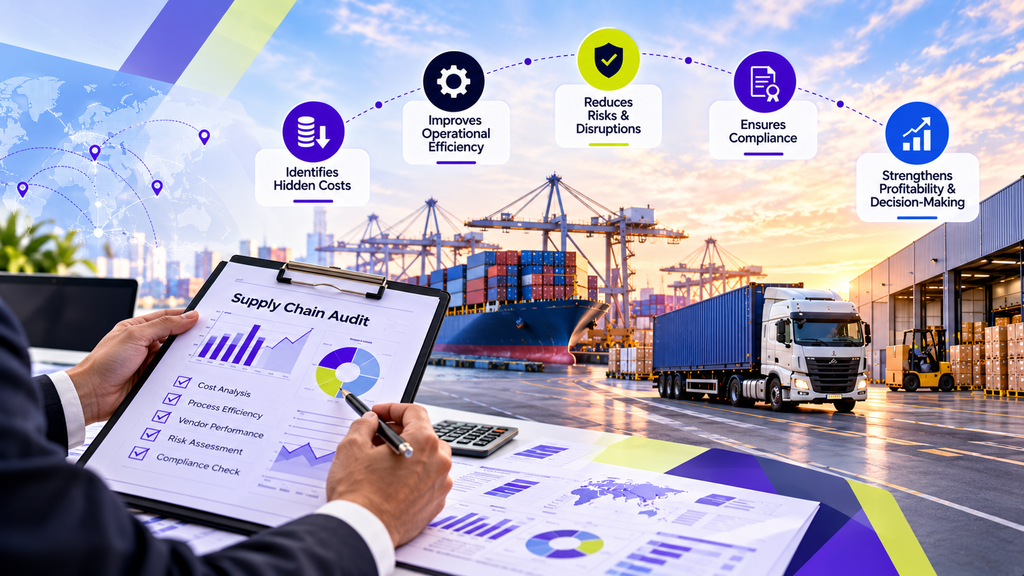
    Supply chain audit expenditure is spread across several functions, departments and external service providers. This makes it difficult to understand the complete cost of operating a supply chain by examining individual transactions alone.

    A freight invoice may be accurate in isolation but inconsistent with the agreed contract. A warehouse may report sufficient inventory while its physical stock records reveal discrepancies. A supplier may meet delivery requirements but create additional costs through incomplete documentation or inconsistent processes.

    Without structured monitoring, these issues can remain unnoticed.

    A supply chain audit helps businesses examine these activities systematically and determine whether the underlying processes are working effectively.

    1. Identify Hidden Cost Leakages

    Hidden cost leakages occur when business expenditure increases because of errors, inefficiencies, duplicate charges, weak controls or contractual discrepancies.

    Examples include:

    • Freight charges that do not match agreed rates
    • Duplicate billing for the same service
    • Unexplained accessorial or additional charges
    • Avoidable detention and demurrage expenses
    • Repeated emergency shipments
    • Excessive warehouse handling costs
    • Inventory discrepancies and avoidable write-offs
    • Inefficient processes that increase labour or operating expenses

    These issues may not always be visible in high-level financial reports. A detailed review of invoices, contracts, operational records and supporting documents can help determine where discrepancies exist and whether corrective action is required.

    2. Improve Cost Visibility

    Businesses need to understand not only how much they spend but also what drives their expenditure.

    A supply chain audit can help organise costs by supplier, transporter, route, warehouse, service category or business location, depending on the data available.

    This makes it easier to compare similar activities, identify unusual variations and understand the factors influencing overall supply chain expenditure.

    Better cost visibility supports more informed budgeting, procurement decisions, contract negotiations and operational planning.

    3. Strengthen Compliance and Internal Controls

    Supply chain audit activities involve contractual commitments, operating procedures, financial approvals and regulatory documentation.

    When controls are weak or inconsistently applied, businesses may face incorrect payments, documentation gaps, contractual non-compliance or avoidable operational risks.

    An audit can evaluate whether transactions are supported by appropriate documentation, approvals and contractual terms. It can also highlight control gaps that require clearer procedures or stronger monitoring.

    4. Improve Operational Efficiency

    Not every supply chain problem is financial in nature. Delays, duplicated activities, unnecessary handling and poor coordination can also affect productivity and service quality.

    A supply chain audit examines the processes behind these outcomes to identify where responsibilities, workflows or operating procedures may need improvement.

    The goal is not simply to reduce expenditure. It is to improve the way resources are used while maintaining appropriate service levels and operational reliability.

    5. Support Better Business Decisions

    Reliable operational and financial information helps management make decisions based on evidence rather than assumptions.

    Audit findings can support decisions about supplier relationships, transporter contracts, warehouse processes, inventory controls, cost allocation and operational priorities.

    When findings are clearly documented and prioritised, management can focus resources on the issues with the greatest financial, operational or compliance significance.

    What Does a Supply Chain Audit Cover?
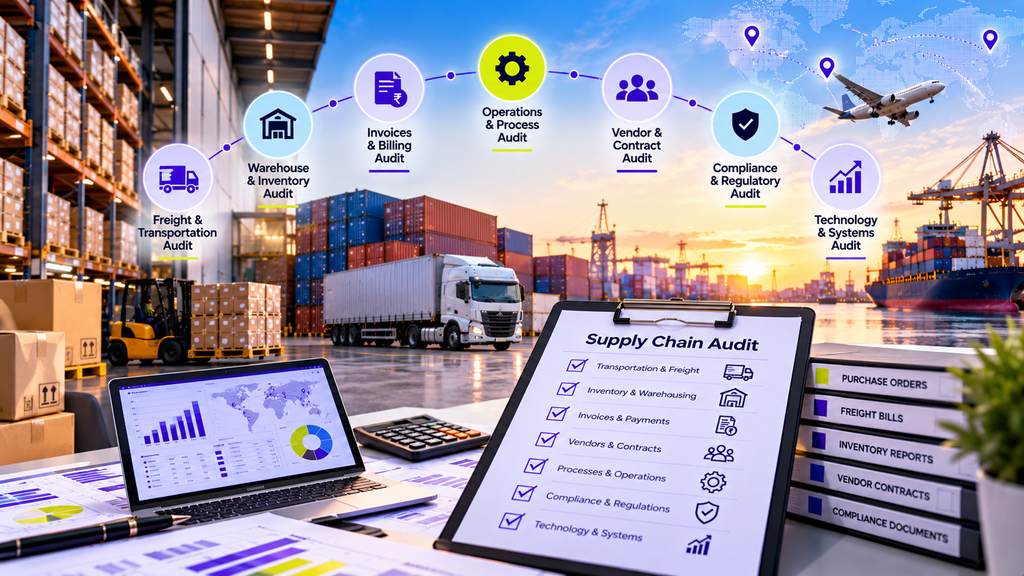
    A supply chain audit can cover several interconnected business functions. The areas reviewed depend on the organisation’s supply chain structure, industry, expenditure patterns and business priorities.

    For many organisations, the following five areas provide a useful starting point.

    1. Freight and Transportation Audit

    Transportation is often a significant supply chain expense, particularly for businesses managing regular shipments, multiple routes and several transporters.

    However, reviewing freight costs involves more than comparing quoted rates. Businesses also need to verify whether the charges applied to actual shipments match the agreed commercial terms.

    A freight and transportation audit may examine:

    • Contracted freight rates versus actual billed rates
    • Freight calculations based on weight, volume, distance or agreed pricing structures
    • Additional charges and their supporting documentation
    • Duplicate or repeated billing
    • Route-level transportation expenditure
    • Detention, demurrage and waiting-time charges
    • Shipment records and proof of delivery
    • Compliance with transporter agreements

    For example, if a transporter applies a different rate from the contracted rate, the discrepancy should be investigated before it is accepted as a valid business expense.

    A structured review helps businesses identify billing inconsistencies and understand the factors contributing to transportation expenditure.

    2. Logistics Operations Audit

    Logistics operations involve the processes used to receive, handle, store, move and deliver goods.

    Inefficiencies in these activities can increase operating costs even when freight rates and supplier prices remain unchanged.

    A logistics operations audit may assess:

    • Loading and unloading processes
    • Warehouse receiving and dispatch procedures
    • Material handling activities
    • Vehicle turnaround time
    • Shipment scheduling and coordination
    • Documentation and process controls
    • Delays and recurring operational bottlenecks
    • Performance against established service requirements

    For instance, repeated delays during loading may increase vehicle waiting time and contribute to additional charges. Reviewing the process can help identify whether the issue relates to staffing, documentation, warehouse readiness or coordination between departments.

    The findings can help businesses identify opportunities to improve workflow efficiency and reduce avoidable operational expenditure.

    3. Customs and Trade Compliance Audit

    Businesses involved in importing and exporting goods must manage documentation, declarations, commercial terms and applicable regulatory requirements.

    Errors or inconsistencies in these activities can lead to delays, additional costs, rework or compliance risks.

    A customs and trade compliance audit may review:

    • Import and export documentation
    • Consistency between relevant commercial and shipping records
    • Applicable customs procedures and requirements
    • Supporting records for declared transactions
    • Coordination with customs brokers and service providers
    • Compliance with applicable contractual and procedural requirements
    • Documentation gaps and control weaknesses

    The review should be aligned with the relevant jurisdictions, regulations and scope of the engagement.

    By examining documentation and processes, businesses can identify areas that require correction, stronger controls or more consistent procedures.

    4. Inventory and Warehousing Audit

    Inventory represents a significant investment for many businesses. Poor inventory visibility, inaccurate records and inefficient warehouse processes can affect working capital, fulfilment performance and operating costs.

    An inventory and warehousing audit may examine:

    • Recorded inventory versus physical stock
    • Inventory movement documentation
    • Receiving, storage and dispatch controls
    • Stock discrepancies and adjustment records
    • Damaged, obsolete or slow-moving inventory
    • Storage utilisation and handling processes
    • Stock reconciliation procedures
    • Access controls and approval processes

    For example, differences between recorded and physical stock may result from transaction errors, unrecorded movements, damaged goods or weaknesses in warehouse procedures.

    A structured audit can help establish where discrepancies occur and whether the underlying controls need improvement.

    5. End-to-End Supply Chain Audit

    Individual reviews can identify problems within specific functions, but some cost leakages arise from the way different functions interact.

    For example, a purchasing decision may affect warehouse storage requirements, which may influence inventory handling, dispatch schedules and transportation costs.

    An end-to-end supply chain audit examines these relationships across the broader operating network.

    Depending on the scope, it may include:

    • Procurement and supplier processes
    • Contract management and commercial controls
    • Freight and transportation expenditure
    • Warehouse and inventory operations
    • Documentation and compliance
    • Coordination between departments
    • Operational performance indicators
    • Financial and process-control weaknesses

    This wider perspective helps businesses understand how decisions in one part of the supply chain can affect costs and performance elsewhere.

    7 Common Hidden Costs a Supply Chain Audit Can Help Identify

    Hidden costs do not always appear as obvious errors in financial records. Some result from incorrect transactions, while others develop gradually through inefficient processes, inconsistent controls or poor coordination.

    A supply chain audit can help investigate the following areas.

    1. Freight Billing Discrepancies

    Freight invoices may contain rates, quantities, distances or additional charges that differ from the applicable contract or shipment records.

    Possible issues include incorrect rate application, unsupported charges, duplicate invoices or calculation errors.

    What businesses should review: Compare freight invoices with the relevant contract, rate card, shipment documentation and proof of delivery. Investigate exceptions before determining whether a charge is valid.

    2. Duplicate Payments and Billing

    Duplicate billing can occur when the same service is invoiced more than once or when similar transactions are processed without adequate checks.

    This can happen across different invoice numbers, departments, locations or payment cycles.

    What businesses should review: Examine invoice references, supplier details, shipment identifiers, service dates and payment records. Use duplicate-detection controls where suitable, followed by verification of flagged transactions.

    3. Contract and Rate Mismatches

    A negotiated contract does not automatically guarantee that every subsequent transaction follows its terms.

    Rate changes, outdated pricing information, incorrect billing rules or inconsistent application of agreed conditions can create discrepancies.

    What businesses should review: Check whether applicable rates, surcharges, service conditions and billing methods align with the approved contract and its effective dates.

    4. Detention, Demurrage and Waiting-Time Charges

    Delays at warehouses, loading points, ports or delivery locations may result in additional charges, depending on the applicable agreement and circumstances.

    Recurring delays can also indicate process problems that are not resolved by paying the additional fees.

    What businesses should review: Compare charge records with arrival and departure timestamps, applicable free-time provisions, delivery schedules and supporting documentation. Identify recurring causes of delay and the departments or locations involved.

    5. Inventory Discrepancies and Avoidable Losses

    Differences between physical stock and system records can affect replenishment decisions, order fulfilment and financial reporting.

    Inventory issues may result from receiving errors, unrecorded movements, damage, incorrect adjustments or inadequate reconciliation.

    What businesses should review: Compare physical counts with inventory records, examine stock adjustments and movement history, and investigate recurring differences by product, location or process.

    6. Inefficient Warehouse and Handling Processes

    Unnecessary movement, repeated handling, poor storage arrangements and delays during receiving or dispatch can increase operating costs.

    These expenses may be spread across labour, equipment, storage and transportation rather than recorded under one obvious cost category.

    What businesses should review: Examine warehouse workflows, handling records, storage utilisation, dispatch performance and recurring operational bottlenecks.

    7. Weak Coordination Between Supply Chain Functions

    Procurement, warehousing, finance and transportation teams often depend on one another to complete a shipment.

    When these functions work with inconsistent information or poorly coordinated schedules, businesses may experience urgent shipments, missed dispatch windows, additional handling and avoidable delays.

    What businesses should review: Trace selected transactions across departments, identify repeated handover problems and evaluate whether responsibilities, approvals and communication procedures are clearly defined.

    These examples illustrate why a supply chain audit should consider both financial transactions and the operational processes behind them. A discrepancy is a signal to investigate, not automatic proof of an overcharge or recoverable saving.

    How Does a Supply Chain Audit Work?

    A structured supply chain audit generally follows a series of steps. The precise methodology depends on the audit objective, the complexity of the operation and the records available.

    Step 1: Define the Audit Scope

    Establish the business objectives, locations, processes, suppliers, expenditure categories and review period. A clear scope keeps the audit focused on relevant risks and questions.

    Step 2: Collect Relevant Data and Documents

    Gather appropriate contracts, invoices, shipment records, inventory reports, operational data, approvals and supporting documents. The quality and completeness of these records influence the reliability of the review.

    Step 3: Examine Transactions and Processes

    Compare actual transactions against contracts, approved procedures and relevant records. Analyse exceptions, unusual variations and recurring operational issues.

    Step 4: Identify and Validate Findings

    Investigate discrepancies, confirm the available evidence, understand root causes and distinguish confirmed issues from items requiring further information.

    Step 5: Recommend Corrective Actions

    Prioritise findings by their financial, operational and compliance significance. Recommend practical actions, assign responsibilities where appropriate and establish ways to monitor implementation.

    A useful audit should go beyond listing discrepancies. It should help management understand what happened, why it happened, what evidence supports the finding and what action could reduce the likelihood of recurrence.

    How to Measure the Effectiveness of a Supply Chain Audit

    Identifying an issue is only one part of an audit. Businesses also need to determine whether corrective actions improve cost control, operational performance and compliance over time.

    The most appropriate measurements depend on the audit scope and the organisation’s objectives.

    1. Freight Cost Accuracy

    Measures whether freight charges align with applicable contracts, approved rates and supporting shipment records.

    2. Invoice Exception Rate

    Tracks the proportion of reviewed invoices containing discrepancies that require investigation.

    A consistently high exception rate may indicate problems with billing processes, master data, contractual interpretation or transaction controls.

    3. Inventory Accuracy

    Measures the alignment between physical inventory and recorded stock quantities.

    The results can help identify weaknesses in stock recording, reconciliation and warehouse controls.

    4. On-Time Delivery Performance

    Tracks whether shipments arrive within agreed delivery windows.

    This indicator helps businesses assess service reliability alongside cost-control initiatives.

    5. Additional Logistics Cost

    Monitors relevant additional expenses, such as detention, demurrage, waiting-time charges or unplanned transportation expenditure.

    Businesses should investigate recurring increases rather than assuming every additional charge is avoidable.

    6. Corrective Action Closure

    Tracks whether agreed corrective actions have been implemented and whether the underlying issues have been addressed.

    This helps management distinguish between an audit that identifies problems and one that contributes to sustained process improvement.

    7. Verified Cost Savings and Cost Avoidance

    Measures the financial impact of implemented improvements where the results can be supported by reliable evidence.

    Cost savings should be calculated using a clearly defined baseline and consistent assumptions. Cost avoidance should be reported separately where appropriate, and potential savings should not be presented as confirmed financial recovery.

    Monitoring these indicators over time helps businesses evaluate whether audit recommendations are producing meaningful improvements.

    Supply Chain Audit vs. Regular Operational Monitoring

    Regular monitoring and supply chain audits serve related but different purposes.

    AreaRegular monitoringSupply chain audit
    Primary purposeTrack ongoing performanceExamine processes, transactions and controls
    Typical approachReview reports and operational indicatorsTest records, compare evidence and investigate exceptions
    Main focusPerformance trends and immediate issuesUnderlying causes, discrepancies and control weaknesses
    FrequencyOften continuous or periodicBased on scope, risk and business requirements
    Typical outputDashboards, reports and alertsDocumented findings and recommendations

    Regular monitoring helps a business understand what is happening. A supply chain audit can investigate why particular results occur and whether the processes and controls behind them are appropriate.

    Both approaches can complement each other. Monitoring may identify an unusual increase in freight expenditure, for example, while an audit investigates whether the increase resulted from rate changes, shipment patterns, billing discrepancies or operational inefficiencies.

    Common Mistakes Businesses Should Avoid During a Supply Chain Audit

    An supply chain audit is most useful when its findings are supported by evidence and connected to practical business decisions. Several mistakes can limit its effectiveness.

    1. Focusing Only on Freight Costs

    Transportation expenditure is important, but other areas such as inventory, warehousing, contracts and compliance may also contain material risks.

    The audit scope should reflect the organisation’s wider supply chain exposure rather than assuming every problem originates in freight.

    2. Reviewing Invoices Without Checking Supporting Records

    An invoice alone may not establish whether a charge is correct.

    Businesses should compare relevant invoices with contracts, shipment records, service confirmations, approvals and other appropriate evidence.

    3. Treating Every Discrepancy as a Confirmed Loss

    Differences in records may have valid explanations, including approved contract variations, timing differences or incomplete documentation.

    Each exception should be investigated before it is classified as an error, an overcharge or a recoverable amount.

    4. Ignoring Root Causes

    Correcting one invoice may resolve an individual discrepancy without preventing similar issues from happening again.

    Businesses should examine whether recurring findings are linked to system configuration, outdated rate information, unclear responsibilities or inadequate approval procedures.

    5. Failing to Prioritise Findings

    Not every issue carries the same level of risk or financial significance.

    Businesses should prioritise findings based on factors such as potential financial impact, frequency, compliance exposure, operational disruption and the strength of supporting evidence.

    6. Not Following Up on Recommendations

    An audit report has limited value if its recommendations are never implemented or reviewed.

    Management should define suitable responsibilities, target dates and follow-up measures to determine whether corrective actions have been completed effectively.

    When Should a Business Consider a Supply Chain Audit?

    A business does not necessarily need to wait for a major financial problem before reviewing its supply chain.

    An audit may be particularly useful when:

    • Transportation or logistics expenditure is increasing without a clear explanation.
    • Freight invoices frequently contain discrepancies.
    • The business has expanded into new locations or markets.
    • Several suppliers, transporters or logistics service providers are involved.
    • Contractual rates and billing practices are difficult to reconcile.
    • Inventory records regularly differ from physical stock.
    • Warehouse delays or handling problems recur.
    • Management has limited visibility into supply chain costs.
    • Internal controls or operating procedures require review.
    • The organisation is preparing for a major contract renewal or operational change.

    The appropriate timing and scope depend on the organisation’s risk profile, operational complexity and business priorities.

    For companies managing multiple locations, large transaction volumes or several service providers, a structured review can help management establish a clearer understanding of how supply chain expenditure and operational controls are performing.

    How Audex Helps Businesses Identify Hidden Supply Chain Costs

    Understanding supply chain audit expenditure requires more than reviewing financial totals. Businesses need to examine the underlying transactions, operating processes, contractual arrangements and controls that influence those costs.

    Audex focuses on supply chain and logistics audit expertise, helping businesses examine operational activities, identify potential inefficiencies and understand where stronger cost control may be required.

    Depending on the scope of the engagement, Audex’s audit services cover five key areas:

    Freight Audit

    Freight audit reviews can help businesses examine transportation charges, contractual rates, supporting documentation and billing accuracy to identify discrepancies that require investigation.

    Logistics Operations Audit

    A logistics operations audit examines relevant processes, operating practices and performance controls to identify potential inefficiencies and opportunities for improvement.

    Customs and Compliance Audit

    Customs and compliance reviews focus on relevant documentation, procedures and controls to identify gaps requiring attention, subject to the applicable regulations and agreed audit scope.

    Inventory Audit

    Inventory audits examine stock records, warehouse controls, inventory movements and reconciliation procedures to identify discrepancies and areas where stronger controls may be needed.

    End-to-End Supply Chain Audit

    An end-to-end review considers how multiple supply chain audit functions interact, helping businesses examine cost drivers, operational processes and control weaknesses across the wider network.

    Through a structured supply chain audit approach, businesses can develop a clearer understanding of their supply chain operations and make more informed decisions about corrective action.

    The objective is not to assume that every business has the same problems. It is to examine the available evidence, identify relevant findings and recommend practical improvements suited to the organisation’s requirements.

    To learn more about Audex’s approach and expertise, visit the About Audex page.

    The Business Value of an Independent Supply Chain Audit

    An independent audit can provide an additional perspective on supply chain processes, transactions and controls.

    When the review is appropriately scoped and supported by reliable evidence, it can help management examine whether established practices are working as intended and whether potential issues require further investigation.

    The business value may include:

    • Better visibility into supply chain expenditure
    • Identification of potential billing discrepancies
    • Improved understanding of recurring operational issues
    • Stronger documentation and transaction controls
    • Better-informed contract and supplier decisions
    • More consistent processes across locations
    • Clearer prioritisation of corrective actions
    • Improved monitoring of operational and financial performance

    However, the value of an audit depends on the quality of the available information, the scope of the review, management’s response to findings and the effectiveness of corrective actions.

    An audit does not automatically guarantee savings or eliminate every risk. Its purpose is to provide an evidence-based understanding of the issues examined and support informed decisions about improvement.

    Conclusion — Audex Insights

    A supply chain audit provides businesses with a structured way to examine expenditure, operational processes, contractual compliance and internal controls.

    By reviewing freight transactions, logistics operations, customs documentation, inventory records and connected supply chain activities, organisations can identify discrepancies, investigate inefficiencies and understand where corrective action may be required.

    The objective is not simply to reduce costs. It is to understand the reasons behind those costs, strengthen control over business processes and improve the reliability of supply chain operations.

    For businesses managing multiple suppliers, transporters, warehouses and distribution locations, a wider audit perspective can reveal issues that may remain hidden when each transaction or department is examined separately.

    A well-planned audit also creates a foundation for continuous improvement by helping management prioritise findings, implement corrective actions and monitor the results.

    Your Supply Chain Costs May Tell Only Half the Story.

    The real opportunity lies in understanding what drives those costs, where controls may be falling short and which improvements can deliver measurable business value.

    Audex helps businesses examine their supply chain and logistics operations through structured audit services focused on cost visibility, operational efficiency and stronger controls.
  • Supplier and Distributor Clustering: 7 Powerful Ways to Reduce Transportation Costs

    Supplier and Distributor Clustering: 7 Powerful Ways to Reduce Transportation Costs

    Learn how Supplier and Distributor Clustering helps businesses optimise routes, consolidate shipments, improve vehicle utilisation and reduce transportation costs.

    Transportation costs are influenced not only by freight rates and vehicle selection but also by the geographic distribution of suppliers, warehouses and customers.

    Businesses operating across multiple locations may unknowingly create transportation inefficiencies through fragmented shipment planning, overlapping routes and poorly coordinated pickup and delivery schedules.

    This is where Supplier and Distributor Clustering becomes valuable.

    Supplier and Distributor Clustering involves analysing the geographic locations of suppliers, distributors and other supply chain partners to identify opportunities for shipment consolidation, route optimisation and more efficient transportation planning.

    Instead of managing every pickup or delivery as an isolated movement, businesses can examine how nearby locations can be coordinated to improve transportation efficiency.

    This article explores seven practical ways Supplier and Distributor Clustering can help businesses reduce avoidable freight expenditure and strengthen supply chain performance.

     What Is Supplier and Distributor Clustering?

    Supplier and Distributor Clustering is the process of grouping geographically nearby suppliers, distributors or delivery points to identify opportunities for more efficient transportation planning.

    The objective is to improve how goods move across the supply chain by examining location patterns, shipment volumes, transportation routes and delivery requirements.

    For example, a business sourcing materials from several suppliers located within the same industrial area may be able to coordinate pickups through a planned milk-run route rather than arranging separate vehicle movements for every supplier.

    Similarly, distributors located within nearby regions may offer opportunities for delivery consolidation, provided shipment requirements and delivery commitments are compatible.

    Supplier and Distributor Clustering can support:

    • Shipment consolidation
    • Route optimization
    • Milk-run planning
    • Improved vehicle utilization
    • Reduced empty kilometers
    • Better transportation scheduling
    • Lower cost per shipment
    • Improved network visibility

    It is particularly relevant for businesses managing multiple suppliers, warehouses, manufacturing facilities and distribution locations.

    Why Supplier and Distributor Clustering Matters

    A transportation network may appear organised when viewed shipment by shipment, but inefficiencies can become visible when locations and movements are analysed together.

    Common transportation challenges include:

     Fragmented Pickup and Delivery Movements

    Multiple vehicles may travel through nearby locations without coordinated scheduling.

    Repeated Route Overlap

    Separate shipments may follow similar routes, creating opportunities for consolidation that are not being used.

     Poor Vehicle Utilisation

    Vehicles may operate below practical capacity because shipment volumes are distributed across uncoordinated movements.

     Excessive Transportation Distance

    Inefficient pickup and delivery sequences can increase kilometres travelled and overall freight expenditure.

     Limited Network Visibility

    Without a consolidated view of supplier and distributor locations, businesses may struggle to identify broader transportation inefficiencies.

    Supplier and Distributor Clustering helps businesses examine these challenges from a network perspective rather than treating each shipment as a separate event.

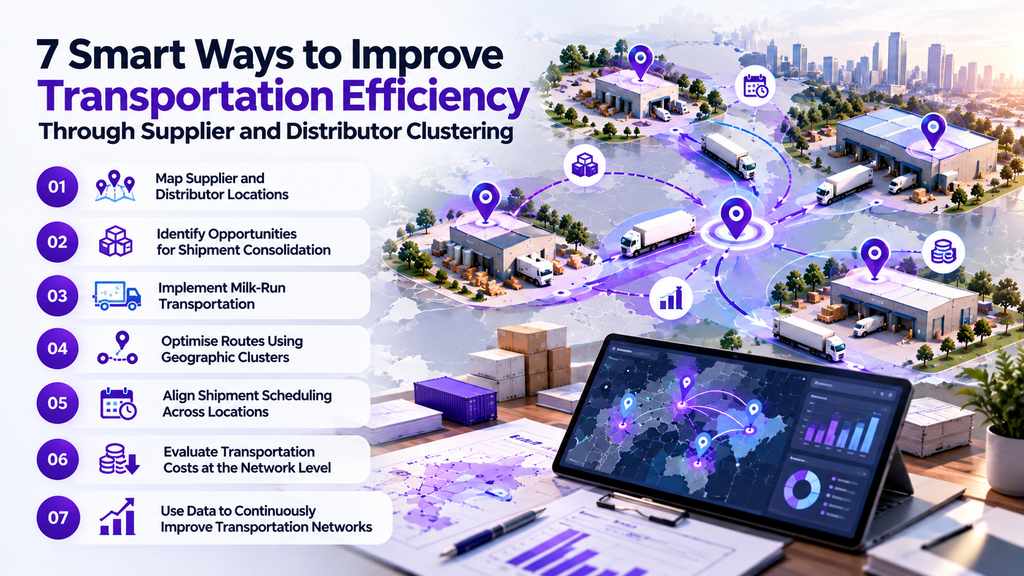
    7 Smart Ways to Improve Transportation Efficiency Through Supplier and Distributor Clustering

    1. Map Supplier and Distributor Locations

    The first step in Supplier and Distributor Clustering is developing a clear understanding of where supply chain partners are located.

    Businesses can map:

    • Supplier locations
    • Distributor locations
    • Warehouses
    • Manufacturing facilities
    • Customer delivery points
    • Existing transportation routes
    • Shipment volumes
    • Delivery frequencies

    Geographic mapping can reveal clusters of locations that may benefit from coordinated transportation planning.

    For example, several suppliers operating within the same industrial zone may be suitable for a consolidated pickup route.

    The objective is to identify practical opportunities based on actual shipment patterns rather than geographic proximity alone.

    2. Identify Opportunities for Shipment Consolidation

    Shipment consolidation involves combining compatible cargo movements to improve transportation efficiency.

    Supplier and Distributor Clustering can help businesses identify locations where multiple shipments may be consolidated.

    Potential opportunities include:

    • Nearby supplier pickups
    • Distributors within the same delivery region
    • Compatible shipment schedules
    • Repeated small-volume movements
    • Common warehouse destinations
    • Similar delivery requirements

    Consolidation can reduce the number of separate vehicle movements required, improve vehicle utilisation and potentially lower the cost per unit transported.

    However, consolidation should account for cargo compatibility, delivery commitments, loading constraints and handling requirements.

    3. Implement Milk-Run Transportation

    A milk-run is a transportation arrangement in which a vehicle follows a planned route to collect goods from multiple suppliers or deliver goods to multiple destinations.

    It can be particularly useful when suppliers or distributors are geographically close and shipment volumes are suitable for coordinated movements.

    For example, instead of arranging separate vehicles for three nearby suppliers, a business may evaluate whether one planned route can collect compatible shipments from all three locations.

    Milk-run planning should consider:

    • Pickup sequence
    • Distance between locations
    • Shipment volume
    • Loading capacity
    • Collection windows
    • Traffic conditions
    • Vehicle suitability
    • Delivery deadlines

    When planned effectively, milk-run transportation can improve vehicle utilisation and reduce unnecessary trips.

    4. Optimise Routes Using Geographic Clusters

    Geographic clustering provides a foundation for more efficient route planning.

    Businesses can evaluate whether existing routes can be redesigned to serve nearby locations more effectively.

    Route optimisation may involve:

    • Reducing overlapping routes
    • Improving pickup sequences
    • Consolidating nearby deliveries
    • Reducing unnecessary kilometres
    • Aligning vehicle capacity with route requirements
    • Coordinating dispatch schedules
    • Reviewing return-load opportunities

    For businesses operating across large distribution networks, even small improvements across frequently used routes may create meaningful operational benefits.

    The objective is to identify efficient transportation patterns without compromising delivery timelines or service requirements.

    5. Align Shipment Scheduling Across Locations

    Geographic proximity alone does not guarantee that shipments can be consolidated.

    Timing is equally important.

    Suppliers and distributors may operate with different loading windows, production schedules and delivery commitments.

    Businesses should examine whether shipment schedules can be coordinated to support more efficient transportation movements.

    This may include:

    • Aligning supplier pickup windows
    • Coordinating warehouse receiving schedules
    • Consolidating dispatch days
    • Planning recurring delivery cycles
    • Matching shipment readiness with vehicle availability
    • Reducing waiting time at pickup and delivery points

    Better coordination can help businesses use transportation capacity more effectively while reducing avoidable delays.

    6. Evaluate Transportation Costs at the Network Level

    A route may appear cost-effective when evaluated individually but become less efficient when compared with the wider transportation network.

    Supplier and Distributor Clustering enables businesses to examine transportation costs across connected locations.

    Useful measurements include:

    • Cost per route
    • Cost per shipment
    • Cost per kilometer
    • Cost per tons
    • Vehicle utilization
    • Number of trips
    • Empty kilometres
    • Pickup and delivery frequency
    • Transit time
    • Total freight expenditure by geographic cluster

    Network-level analysis can help identify where consolidation, route redesign or scheduling changes may improve overall transportation efficiency.

    This is particularly valuable for businesses managing multiple distribution centres or extensive supplier networks.

     7. Use Data to Continuously Improve Transportation Networks

    Supplier and Distributor Clustering should not be treated as a one-time exercise.

    Shipment volumes, supplier locations, customer demand and distribution requirements can change over time.

    Businesses should regularly review transportation data to identify new opportunities and assess whether existing routes remain efficient.

    Useful data sources include:

    • Shipment history
    • Supplier and distributor addresses
    • Order volumes
    • Freight invoices
    • Vehicle utilization reports
    • Delivery performance
    • Route distances
    • Transportation schedules
    • Warehouse movement records

    Regular analysis helps businesses identify changing shipment patterns and make informed decisions about network design.

    A data-driven approach supports continuous improvement rather than relying on outdated transportation arrangements.

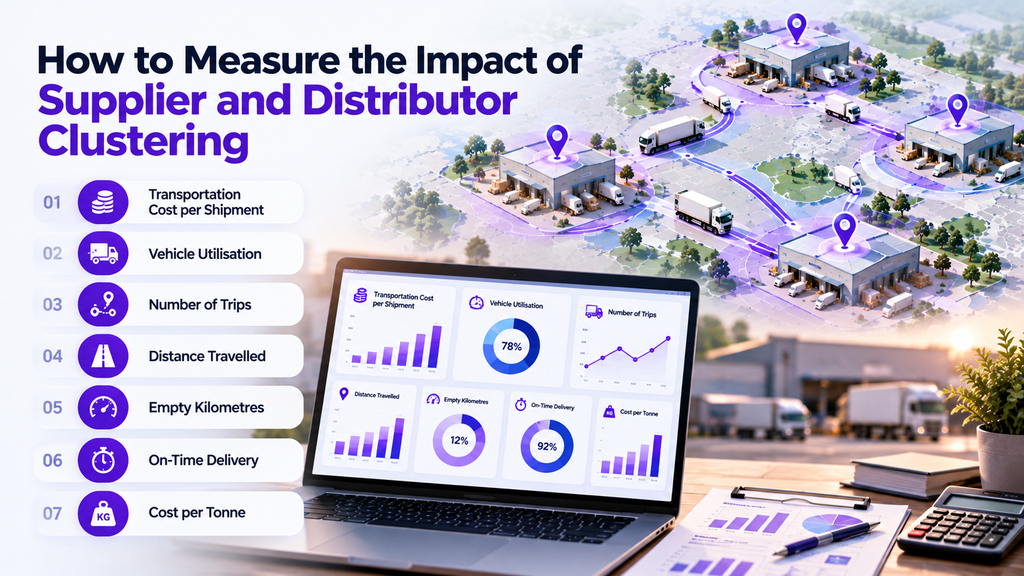
    How to Measure the Impact of Supplier and Distributor Clustering

    The effectiveness of Supplier and Distributor Clustering should be measured using operational and cost indicators.

    Transportation Cost per Shipment

    Measures the average transportation expenditure associated with each shipment.

    Vehicle Utilisation

    Tracks how effectively available vehicle capacity is being used.

    Number of Trips

    Helps identify whether consolidation has reduced the number of separate vehicle movements.

     Distance Travelled

    Measures route distance and helps identify changes in transportation efficiency.

     Empty Kilometres

    Tracks vehicle movements without cargo and highlights opportunities for improved utilisation.

    On-Time Delivery

    Ensures that transportation efficiency improvements do not compromise customer commitments.

    Cost per Tone

    Helps businesses compare transportation expenditure against the quantity of goods moved.

    Monitoring these indicators provides a clearer understanding of whether clustering initiatives are delivering operational benefits.

    Supplier and Distributor Clustering and Transportation Cost Optimisation

    Supplier and Distributor Clustering is closely connected to transportation cost optimisation because it focuses on improving how goods move across the network.

    However, clustering should not be viewed as simply combining as many shipments as possible.

    Effective transportation optimisation requires businesses to balance:

    • Freight expenditure
    • Delivery timelines
    • Vehicle capacity
    • Cargo compatibility
    • Route efficiency
    • Operational flexibility
    • Customer service requirements

    A well-designed transportation network considers the relationship between locations, shipment volumes and delivery priorities.

    The goal is to reduce avoidable transportation costs while maintaining reliable supply chain operations.

     Common Supplier and Distributor Clustering Mistakes

    Businesses may struggle to realise the benefits of clustering when planning decisions are based on incomplete information.

    Common mistakes include:

    • Grouping locations based only on geographic proximity
    • Ignoring shipment weight and volume
    • Overlooking delivery commitments
    • Failing to consider loading and unloading times
    • Combining incompatible cargo
    • Ignoring vehicle capacity
    • Not reviewing route-level costs
    • Failing to monitor delivery performance
    • Treating clustering as a one-time exercise

    A structured approach that considers both geography and operational requirements can help businesses avoid these issues.

    How Audex Can Help With Supplier and Distributor Clustering

    Improving transportation network efficiency requires visibility into shipment movements, freight expenditure, route performance and operational requirements.

    Audex helps businesses evaluate transportation and supply chain operations by examining areas such as transportation planning, network efficiency, vehicle utilisation, freight costs and delivery performance.

    A structured transportation audit can help identify:

    • Supplier and distributor clustering opportunities
    • Inefficient transportation routes
    • Shipment consolidation possibilities
    • Vehicle utilization gaps
    • Excessive transportation movements
    • Freight cost inefficiencies
    • Network planning challenges
    • Opportunities for better transportation coordination

    By examining transportation operations at the network level, businesses can gain a clearer understanding of where operational improvements may be possible.

    Conclusion ( Audex Insights )

    Supplier and Distributor Clustering provides businesses with a structured way to examine transportation networks and identify opportunities for greater efficiency.

    By mapping locations, consolidating compatible shipments, implementing milk-run routes, improving scheduling and analysing transportation costs at the network level, businesses can make more informed logistics decisions.

    The objective is not simply to reduce the number of vehicles on the road. It is to ensure that transportation movements are planned effectively, available capacity is used appropriately and delivery requirements continue to be met.

    When suppliers, distributors and transportation routes are viewed as part of one connected network, businesses gain a clearer picture of where efficiency opportunities exist.

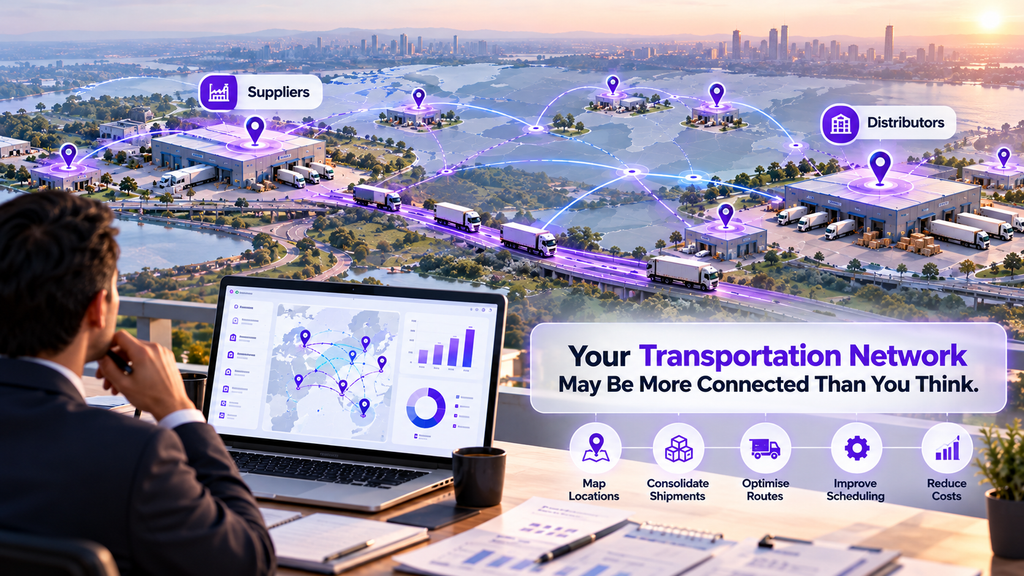
     Your Transportation Network May Be More Connected Than You Think.

    A detailed transportation and logistics audit can help identify opportunities to improve route planning, shipment consolidation and network efficiency.

    Explore Audex transportation and supply chain audit solutions to understand how Supplier and Distributor Clustering can support better transportation cost management.

  • Full Truckload Transportation: 7 Proven Ways to Maximise Efficiency and Reduce Freight Costs

    Full Truckload Transportation: 7 Proven Ways to Maximise Efficiency and Reduce Freight Costs

    Discover how Full Truckload Transportation can improve vehicle utilisation, reduce freight costs, optimise routes and strengthen logistics efficiency.

    Full Truckload Transportation: 7 Proven Ways to Maximise Efficiency and Reduce Freight Costs

    Full Truckload Transportation plays a significant role in the movement of goods across manufacturing, distribution and supply chain networks. For businesses transporting large volumes of products, selecting the right vehicle and maximising its capacity can directly influence transportation expenditure and delivery performance.

    However, simply booking a full truck does not guarantee transportation efficiency.

    Poor load planning, inefficient routes, vehicle underutilisation, inconsistent transporter performance and unnecessary empty kilometres can increase the actual cost of transportation.

    Full Truckload Transportation efficiency depends on how effectively businesses plan, utilise and manage their available transportation capacity.

    By examining shipment patterns, vehicle capacity, route requirements and transporter performance, businesses can identify opportunities to improve load utilisation and control freight expenditure.

    This article explores seven practical ways to improve Full Truckload Transportation efficiency and build a more cost-effective logistics operation.

    What Is Full Truckload Transportation?

    Full Truckload Transportation, commonly known as FTL transportation, refers to a shipping arrangement in which an entire truck is allocated to a shipment or a customer’s transportation requirement.

    FTL is generally suitable for businesses transporting large shipment volumes, heavier cargo or goods requiring dedicated vehicle movement.

    Unlike Part Truckload transportation, where cargo from multiple shipments may share vehicle capacity, FTL typically provides dedicated transportation for the allocated load.

    Businesses use Full Truckload Transportation for:

    • Large-volume shipments
    • Manufacturing and industrial goods
    • Inter-warehouse transfers
    • Bulk distribution
    • Dedicated customer deliveries
    • Time-sensitive shipments
    • Goods requiring specific handling arrangements

    While FTL offers operational advantages, its cost-effectiveness depends on proper vehicle selection, load planning, route optimisation and transporter management.

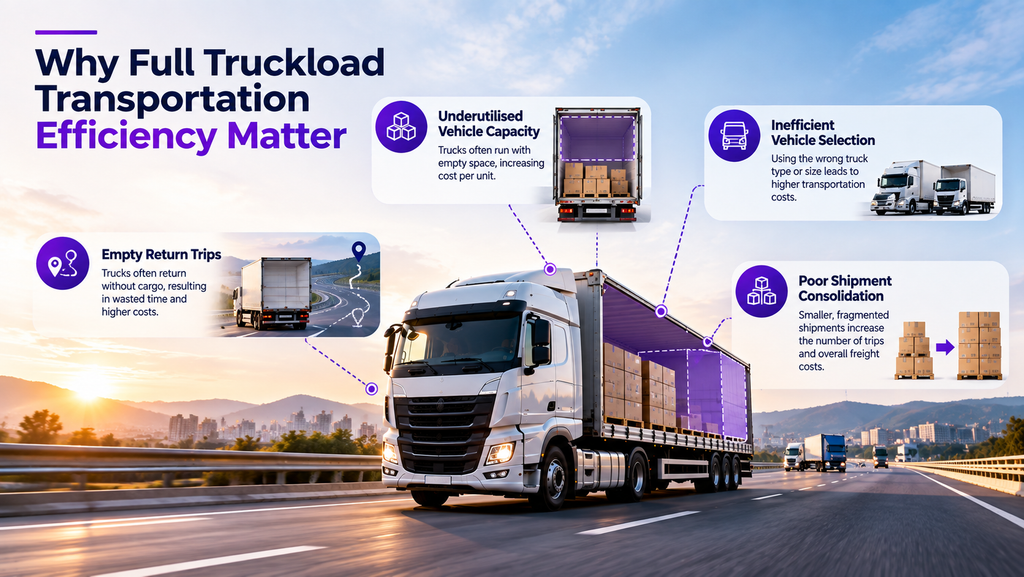
    Why Full Truckload Transportation Efficiency Matters?

    Transportation costs are influenced by several operational factors beyond the freight rate.

    A truck that travels with unused capacity may result in businesses paying for transportation resources that are not being fully utilised.

    Similarly, poor route planning and inefficient shipment scheduling can increase total transportation expenditure.

    Common challenges include:

    Underutilised Vehicle Capacity

    When the shipment does not use the available vehicle capacity effectively, the cost per unit transported may increase.

    Inefficient Vehicle Selection

    Selecting a vehicle that is larger or smaller than the shipment requirement can affect freight cost and operational efficiency.

     Empty Return Trips

    Vehicles returning without cargo may create additional transportation costs, particularly across routes with limited return-load opportunities.

    Poor Shipment Consolidation

    Multiple shipments moving toward similar destinations may create opportunities for consolidation that businesses fail to identify.

    Unplanned Transportation Requirements

    Last-minute shipments can lead to premium freight charges and limited vehicle availability.

    These challenges demonstrate why Full Truckload Transportation requires continuous planning and performance monitoring.

    7 Proven Ways to Improve Full Truckload Transportation Efficiency

    1. Maximise Vehicle Capacity Utilisation

    Vehicle capacity utilisation is one of the most important factors influencing Full Truckload Transportation efficiency.

    Businesses should evaluate whether the selected vehicle is appropriate for the shipment’s weight, volume and handling requirements.

    Important considerations include:

    • Available vehicle capacity
    • Shipment weight
    • Cargo volume
    • Load dimensions
    • Weight restrictions
    • Loading arrangements
    • Vehicle suitability
    • Actual load factor

    For example, a shipment may meet the vehicle’s weight limit but leave substantial unused volume. In such cases, businesses can examine whether a different vehicle configuration or shipment consolidation arrangement would improve utilisation.

    The objective is to transport the maximum feasible cargo within applicable safety, legal and operational limits.

    Better vehicle utilisation can help reduce the transportation cost per unit of cargo moved.

     2. Select the Right Vehicle for Every Shipment

    Not every shipment requires the same vehicle type.

    Selecting vehicles based only on availability or routine practice may result in unnecessary transportation expenditure.

    Businesses should consider:

    • Shipment weight
    • Cargo dimensions
    • Loading and unloading requirements
    • Delivery location
    • Route conditions
    • Transit-time expectations
    • Vehicle capacity
    • Freight pricing structure

    A structured vehicle selection process helps businesses match transportation capacity with actual shipment requirements.

    This can reduce underutilisation and improve freight cost management without compromising delivery commitments.

    3. Consolidate Shipments Wherever Feasible

    Shipment consolidation can improve Full Truckload Transportation efficiency by combining compatible cargo movements.

    Businesses may identify consolidation opportunities across:

    • Similar delivery locations
    • Nearby distribution centres
    • Supplier clusters
    • Scheduled dispatches
    • Repeated shipment patterns
    • Compatible product categories

    For example, two smaller shipments moving toward the same destination may be consolidated into one vehicle if delivery timelines, cargo compatibility and operational requirements permit.

    Consolidation should be planned carefully to avoid delays or additional handling costs.

    When implemented appropriately, it can help businesses reduce unnecessary trips and improve vehicle utilisation.

     4. Optimise Routes and Reduce Empty Kilometres

    Transportation cost is influenced by the distance travelled, route conditions and vehicle movement patterns.

    Poorly planned routes may increase fuel consumption, transit time and total freight expenditure.

    Businesses can review:

    • Actual distance travelled
    • Planned versus actual routes
    • Return-load opportunities
    • Delivery sequencing
    • Traffic conditions
    • Route-specific freight costs
    • Vehicle turnaround time
    • Repeated empty movements

    Identifying suitable return-load opportunities can help improve asset utilisation and reduce the cost associated with empty kilometres.

    Route optimisation should consider both outbound and return movements rather than evaluating individual shipments in isolation.

    5. Improve Transportation Planning and Scheduling

    Unplanned dispatches can create avoidable costs and operational pressure.

    Effective transportation planning aligns shipment requirements with vehicle availability, delivery schedules and business priorities.

    Businesses can improve planning by:

    * Forecasting shipment volumes

    • Scheduling dispatches in advance
    • Coordinating warehouse readiness
    • Aligning vehicle placement with loading schedules
    • Consolidating compatible orders
    • Monitoring peak-period requirements
    • Reducing avoidable last-minute bookings

    Better coordination between procurement, production, warehousing and transportation teams can improve vehicle availability and reduce unnecessary waiting time.

    6. Monitor Transporter Performance and Freight Rates

    A competitive freight rate is only one measure of transporter performance.

    Businesses should evaluate whether transporters consistently provide the required vehicle type, meet delivery commitments and comply with agreed commercial terms.

    Important performance indicators include:

    • Freight rate compliance
    • On-time vehicle placement
    • On-time delivery
    • Vehicle availability
    • Transit-time consistency
    • Shipment damage frequency
    • Billing accuracy
    • Response time
    • Service-level compliance

    Regular performance reviews can help businesses identify transporters who support reliable Full Truckload Transportation operations.

    It also provides a basis for reviewing route allocations, contractual terms and opportunities for improvement.

    7. Use Transportation Data to Identify Cost Leakage

    Data-driven transportation management helps businesses understand where costs are increasing and why.

    Rather than reviewing freight expenditure only at the end of the month, businesses can monitor operational indicators regularly.

    Useful metrics include:

    • Cost per kilometre
    • Cost per tonne
    • Cost per shipment
    • Vehicle utilisation percentage
    • Empty kilometre ratio
    • On-time delivery percentage
    • Vehicle turnaround time
    • Freight cost by route
    • Freight billing discrepancies
    • Actual versus planned transportation expenditure

    These measurements help businesses identify recurring inefficiencies and make informed transportation decisions.

    A structured review of transportation data can also reveal opportunities that may remain hidden in individual shipment records.

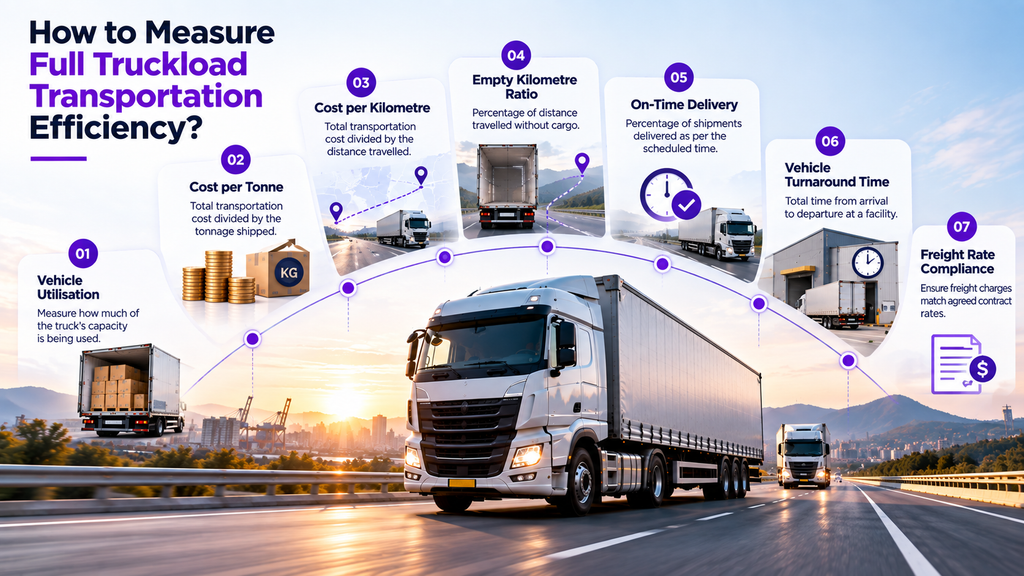
     How to Measure Full Truckload Transportation Efficiency?

    Full Truckload Transportation efficiency should be evaluated using both cost and service performance indicators.

     Vehicle Utilisation

    Measures how effectively available vehicle capacity is being used.

    Cost per Tonne

    Helps businesses understand the transportation cost associated with moving a unit of cargo.

    Cost per Kilometre

    Provides visibility into route-level transportation expenditure.

    Empty Kilometre Ratio

    Measures the proportion of vehicle distance travelled without cargo.

    On-Time Delivery

    Tracks whether shipments reach their destinations within committed timelines.

    Vehicle Turnaround Time

    Measures the time taken for a vehicle to complete its assigned transportation cycle and become available for another movement.

    Freight Rate Compliance

    Checks whether actual freight charges match agreed contractual rates.

    Monitoring these indicators together provides a more complete picture of transportation efficiency than freight expenditure alone.

    Full Truckload Transportation and Freight Cost Optimisation

    Full Truckload Transportation and freight cost optimisation are closely connected?

    However, reducing freight rates without examining vehicle utilisation, route efficiency and shipment planning may not address the underlying causes of transportation expenditure.

    A comprehensive approach considers:

    • Vehicle selection
    • Load consolidation
    • Route planning
    • Transporter performance
    • Return-load opportunities
    • Freight bill validation
    • Shipment scheduling
    • Operational performance

    The objective is to reduce avoidable costs while maintaining delivery reliability and service quality.

     Common Full Truckload Transportation Mistakes?

    Businesses may overlook significant efficiency opportunities when transportation planning is not supported by reliable data.

    Common mistakes include:

    • Selecting vehicles without evaluating shipment requirements
    • Ignoring unused vehicle capacity
    • Failing to examine return-load opportunities
    • Overlooking shipment consolidation
    • Evaluating freight rates without considering total transportation cost
    • Not monitoring transporter performance
    • Allowing repeated emergency shipments
    • Ignoring route-level cost differences
    • Failing to measure vehicle turnaround time

    Addressing these issues can help businesses establish a more structured approach to Full Truckload Transportation management.

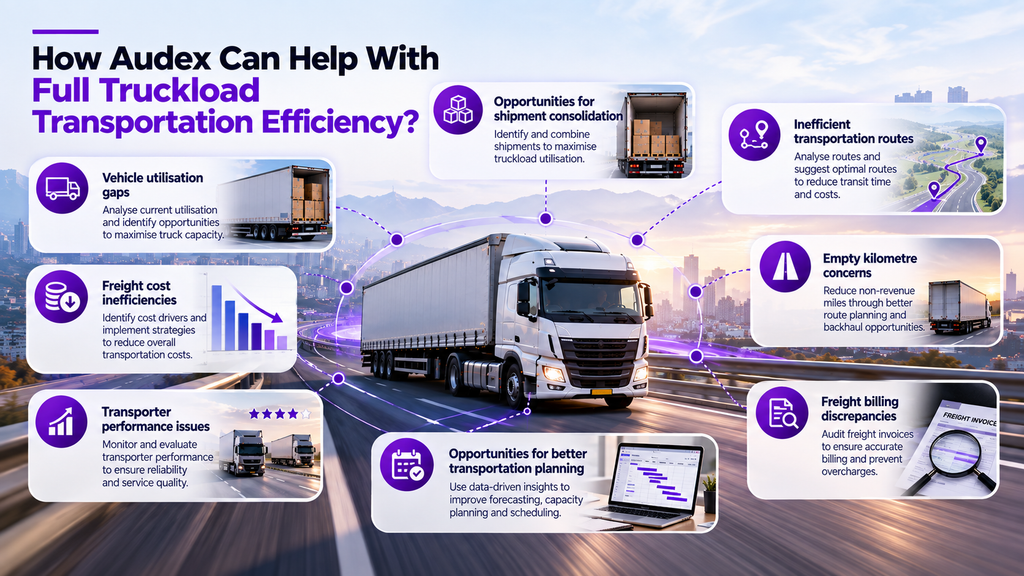
    How Audex Can Help With Full Truckload Transportation Efficiency?

    Improving Full Truckload Transportation efficiency requires visibility into freight expenditure, vehicle utilisation, transportation planning and operational performance.

    Audex helps businesses evaluate logistics and transportation operations by examining areas such as freight costs, vehicle utilisation, route efficiency, transporter performance and supply chain processes.

    A structured transportation audit can help identify:

    • Vehicle utilisation gaps
    • Freight cost inefficiencies
    • Opportunities for shipment consolidation
    • Inefficient transportation routes
    • Empty kilometre concerns
    • Transporter performance issues
    • Freight billing discrepancies
    • Opportunities for better transportation planning

    By analysing transportation operations beyond individual freight quotations, businesses can identify opportunities to improve efficiency and strengthen cost control.

    Conclusion ( Audex insights )

    Full Truckload Transportation efficiency is not determined by freight rates alone.

    It depends on how effectively businesses select vehicles, utilise capacity, consolidate shipments, plan routes and manage transporter performance.

    By combining structured transportation planning with regular performance monitoring and reliable operational data, businesses can identify avoidable expenses and improve the efficiency of their transportation networks.

    The objective is simple: move more efficiently, utilise available capacity effectively and understand the true cost of every transportation movement.

    Before Booking the Next Truck, Understand the Cost of the Current One.

    A detailed transportation audit can help reveal vehicle utilisation gaps, route inefficiencies and opportunities for better freight cost management.

    Explore Audex transportation and supply chain audit solutions to identify opportunities for improved Full Truckload Transportation efficiency.

  • Transporter Selection: 7 Proven Ways to Avoid Costly Logistics Mistakes

    Transporter Selection: 7 Proven Ways to Avoid Costly Logistics Mistakes

    Discover how effective transporter selection helps businesses reduce freight costs, improve delivery reliability, evaluate performance and strengthen supply chain efficiency.

    Choosing the right transporter is one of the most important decisions in transportation management. A transporter directly influences freight expenditure, delivery timelines, vehicle availability, shipment safety and overall supply chain performance.

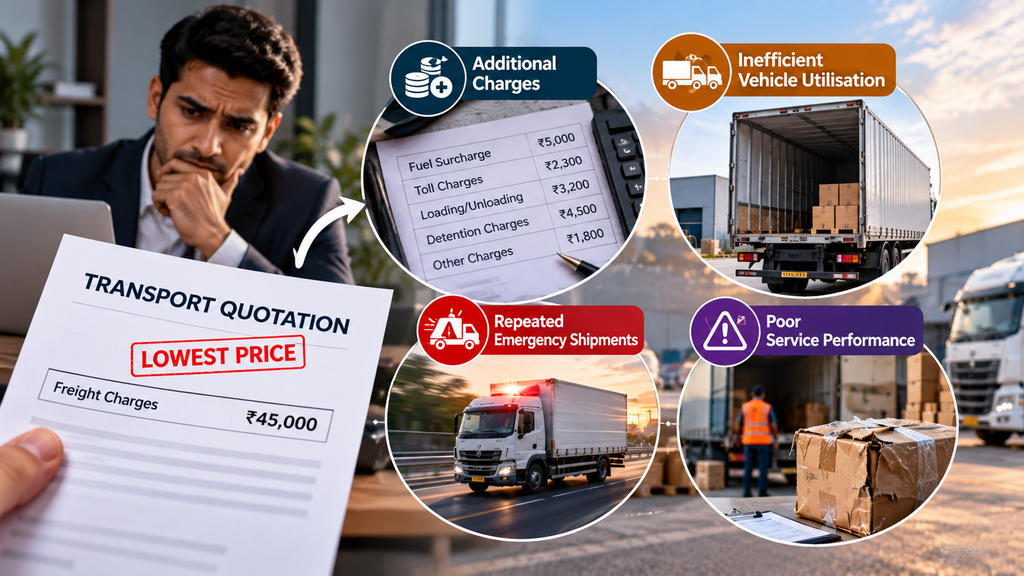
    However, many businesses still approach transporter selection primarily as a price comparison exercise. While competitive freight rates matter, selecting a logistics partner based only on the lowest quotation can create operational challenges that eventually cost more than the initial savings.

    Effective transporter selection requires businesses to evaluate cost, reliability, capacity, route coverage, service quality and performance together.

    A transporter offering a lower rate may not necessarily deliver the lowest total transportation cost if frequent delays, damages, billing discrepancies or vehicle shortages affect operations.

    This article explores seven practical ways to improve transporter selection, strengthen transporter management and make more informed transportation decisions.

    What Is Transporter Selection?

    Transporter selection is the process of identifying, evaluating and appointing logistics service providers based on business requirements, transportation costs, operational capabilities and service performance.

    The objective is to select transporters who can consistently meet delivery requirements while maintaining cost efficiency and operational reliability.

    An effective transporter selection process considers:

    • Freight rates and pricing structures
    • Vehicle availability and capacity
    • Geographic coverage
    • Delivery performance
    • Shipment safety
    • Service-level compliance
    • Billing accuracy
    • Operational flexibility
    • Historical performance
    • Ability to support changing business volumes

    A structured approach helps businesses move beyond informal decisions and establish a more transparent, measurable transporter selection process.

    Why Choosing the Right Transporter Matters

    Transporters play a critical role in connecting suppliers, warehouses, manufacturing facilities, distributors and customers.

    An unsuitable transportation partner can affect multiple areas of business operations.

    Increased Transportation Costs

    A low initial quotation may be offset by additional charges, inefficient vehicle utilisation, repeated emergency shipments or poor service performance.

    Delivery Delays

    Unreliable transportation can disrupt production schedules, inventory availability and customer commitments.

     Vehicle Availability Issues

    Transporters who cannot provide vehicles when required may create shipment backlogs and force businesses to arrange expensive alternatives.

    Shipment Damages and Shortages

    Poor handling, inadequate controls and inconsistent service quality can result in product losses and additional operational costs.

    Limited Operational Flexibility

    Businesses experience fluctuations in demand. Transporters who cannot adapt to changing volumes, routes or delivery priorities may restrict operational efficiency.

    These challenges demonstrate why transporter selection should be treated as a strategic transportation decision rather than a routine purchasing activity.

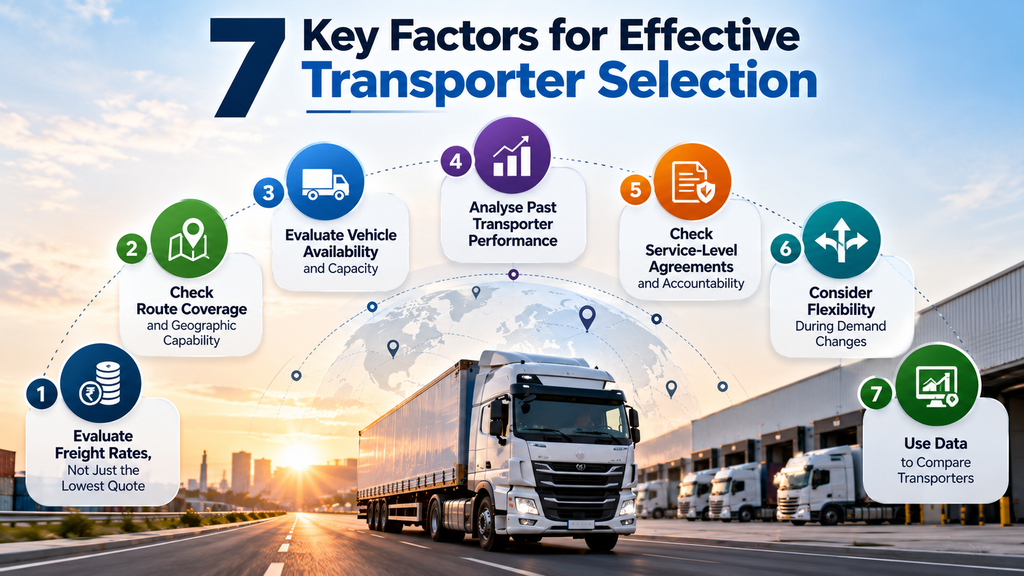
    7 Key Factors for Effective Transporter Selection

    1. Evaluate Freight Rates, Not Just the Lowest Quote

    Freight pricing is an important part of transporter selection, but the lowest quotation does not always represent the most economical option.

    Businesses should evaluate the complete cost structure before appointing a transporter.

    Consider:

    • Base freight rates
    • Additional transportation charges
    • Fuel surcharges
    • Detention charges
    • Loading and unloading costs
    • Minimum billing conditions
    • Rate validity periods
    • Contractual terms

    Comparing transporters using consistent pricing parameters helps businesses identify the actual cost of transportation.

    A transparent comparison also reduces the risk of selecting a transporter whose initial quotation appears competitive but results in higher expenditure over time.

    2.Check Route Coverage and Geographic Capability

    A transporter may offer competitive pricing but lack adequate coverage across the routes required by the business.

    Route capability should therefore be a key consideration during transporter selection.

    Businesses should examine:

    • Serviceable locations
    • Route familiarity
    • Availability of vehicles across regions
    • Delivery frequency
    • Transit times
    • Return-load opportunities
    • Network strength
    • Ability to support multiple destinations

    For businesses operating across several states or distribution centres, geographic coverage can significantly influence transportation efficiency.

    Selecting transporters based on route-specific capabilities can help improve service reliability and reduce unnecessary transportation complications.

    3. Evaluate Vehicle Availability and Capacity

    Vehicle availability directly affects a business’s ability to meet shipment schedules.

    A transporter may have suitable pricing and route coverage but still struggle to provide the required vehicle type at the right time.

    Businesses should assess:

    • Fleet availability
    • Vehicle types
    • Load capacity
    • Vehicle condition
    • Availability during peak periods
    • Full Truckload and Part Truckload capabilities
    • Flexibility to accommodate urgent requirements

    The right vehicle should match the shipment’s weight, volume, delivery requirements and transportation route.

    Effective transporter selection considers whether a logistics partner can consistently provide the right capacity rather than simply promising availability.

    4. Analyse Past Transporter Performance

    Historical performance provides valuable insight into a transporter’s ability to meet operational expectations.

    Businesses should establish measurable performance indicators instead of relying entirely on personal experience or informal feedback.

    Important performance metrics include:

    • On-time delivery percentage
    • Vehicle placement compliance
    • Shipment damage frequency
    • Shortage incidents
    • Transit-time consistency
    • Customer complaints
    • Billing accuracy
    • Response time
    • Service-level compliance

    Regular performance reviews help businesses identify reliable transporters, recognise recurring issues and make informed decisions about future allocations.

    Performance-based transporter selection also encourages accountability and continuous improvement.

    5. Check Service-Level Agreements and Accountability

    A clear Service Level Agreement (SLA) establishes expectations between a business and its transportation partner.

    Without defined performance standards, it becomes difficult to evaluate service quality or address recurring failures.

    An effective SLA may cover:

    • Vehicle placement timelines
    • Delivery commitments
    • Shipment tracking
    • Reporting requirements
    • Damage and shortage procedures
    • Escalation mechanisms
    • Billing conditions
    • Performance reviews
    • Penalties or corrective actions, where contractually agreed

    Businesses should ensure that service expectations are communicated clearly before appointing transporters.

    A structured accountability framework helps create consistency across transportation operations and supports better transporter management.

    6.Consider Flexibility During Demand Changes

    Transportation requirements rarely remain constant throughout the year.

    Seasonal demand, production changes, new distribution locations and urgent customer orders can affect vehicle requirements and shipment volumes.

    Transporter selection should therefore consider operational flexibility.

    Businesses can evaluate whether transporters can:

    • Accommodate changing shipment volumes
    • Support additional routes
    • Provide vehicles during peak periods
    • Handle urgent deliveries
    • Adjust to changing delivery schedules
    • Coordinate with multiple warehouses
    • Respond quickly to operational disruptions

    A flexible transportation partner can help businesses manage fluctuations without unnecessarily increasing operational complexity.

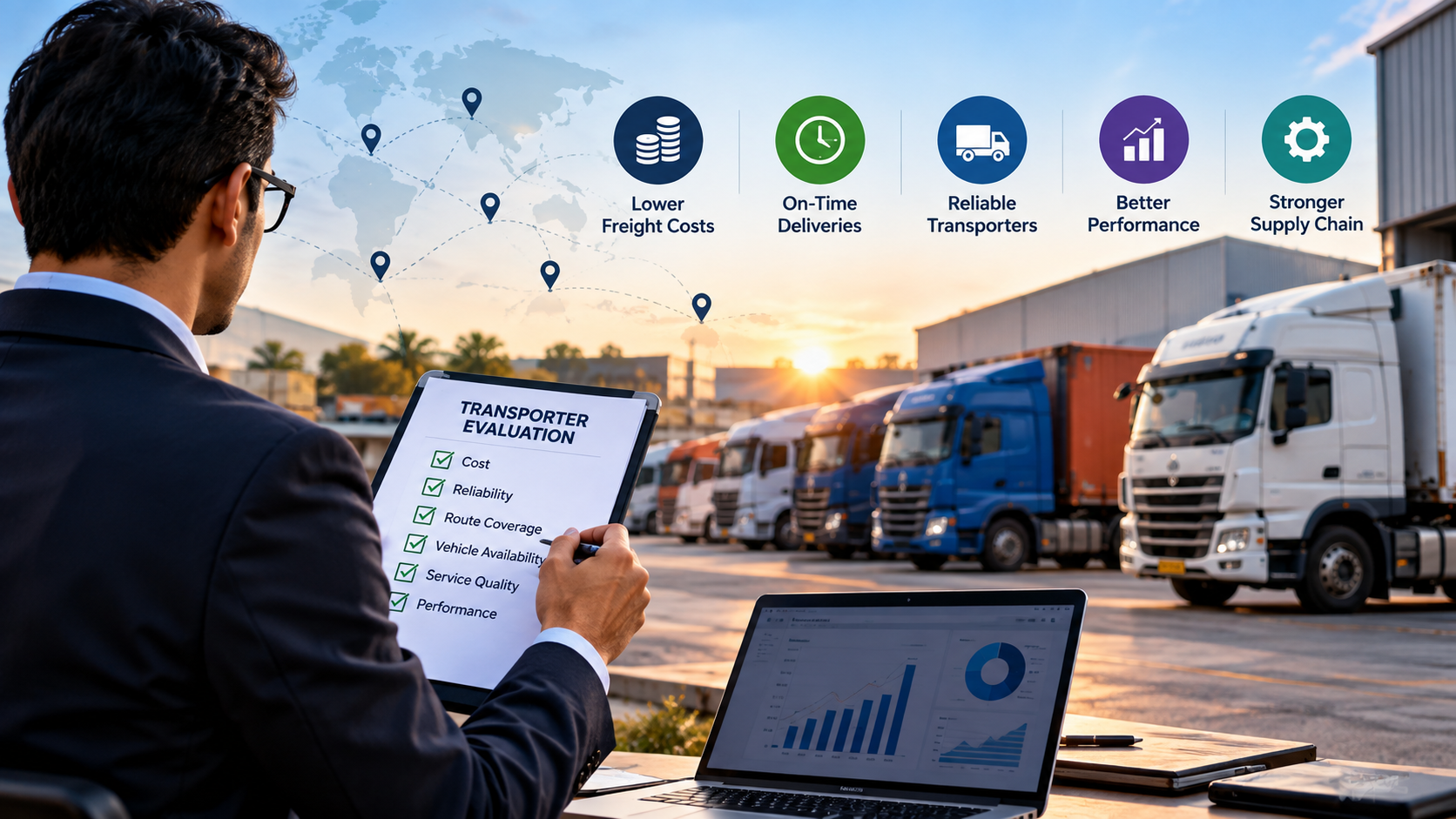
    7. Use Data to Compare Transporters

    Data-driven transporter selection reduces dependence on assumptions and inconsistent evaluation methods.

    Businesses can develop a transporter scorecard that compares service providers against standard criteria.

    A transporter evaluation framework may include:

     Evaluation ParameterWhat to Measure 
    Freight Cost Rate competitiveness and additional charges
    Delivery PerformanceOn-time delivery and transit consistency
    Vehicle AvailabilityPlacement reliability and capacity
    Shipment SafetyDamage and shortage frequency
    Route Coverage  Geographic reach and serviceability
    Billing AccuracyInvoice discrepancies and rate compliance
    ResponsivenessCommunication and issue resolution
    SLA ComplianceAdherence to agreed service standards

    A consistent evaluation framework helps businesses compare transporters objectively and identify areas requiring improvement.

    The purpose is not simply to rank transporters by price. It is to understand which transportation partners meet the organisation’s operational and commercial requirements.

    How to Evaluate Transporter Performance

    Transporter selection should not end once a contract is signed.

    Continuous performance monitoring is essential to ensure that appointed transporters continue meeting business expectations.

    Businesses can establish periodic reviews using operational data and performance indicators.

    A structured transporter performance review should examine:

    Cost Performance: Are agreed freight rates being followed? Are additional charges justified and documented?

    Delivery Performance: Are shipments reaching their destinations within committed timelines?

    Vehicle Placement: Are vehicles being provided according to agreed schedules?

    Shipment Quality: Are damages, shortages and handling issues being reported and addressed?

    Service Reliability: Does the transporter respond effectively to operational changes and unexpected situations?

    Billing Accuracy: Are invoices consistent with contractual terms and actual transportation movements?

    Regular reviews help businesses identify performance gaps early and take corrective action where necessary.

     The Role of Transporter Management in Transportation Cost Optimisation

    Transporter management and transportation cost optimisation are closely connected.

    Even a well-designed transporter selection process can lose its effectiveness without continuous monitoring and performance evaluation.

    A structured transporter management approach can help businesses:

    • Improve freight cost visibility
    • Monitor service-level compliance
    • Identify recurring delivery delays
    • Reduce avoidable transportation expenses
    • Improve vehicle utilisation
    • Strengthen transporter accountability
    • Evaluate alternative transportation partners
    • Support better route allocation decisions

    When transporter performance is measured consistently, businesses can make more informed decisions about transportation planning and resource allocation.

    Common Transporter Selection Mistakes

    Businesses may face avoidable transportation challenges when transporter selection is not supported by a clear evaluation process.

    Common mistakes include:

    • Selecting transporters exclusively on the basis of freight rates
    • Ignoring historical delivery performance
    • Failing to verify vehicle availability
    • Overlooking route-specific capabilities
    • Not establishing measurable service standards
    • Relying on informal feedback instead of operational data
    • Failing to review transporter performance after appointment
    • Not maintaining alternative transportation options
    • Ignoring recurring billing discrepancies

    Avoiding these mistakes can help businesses establish a more reliable and transparent transportation network.

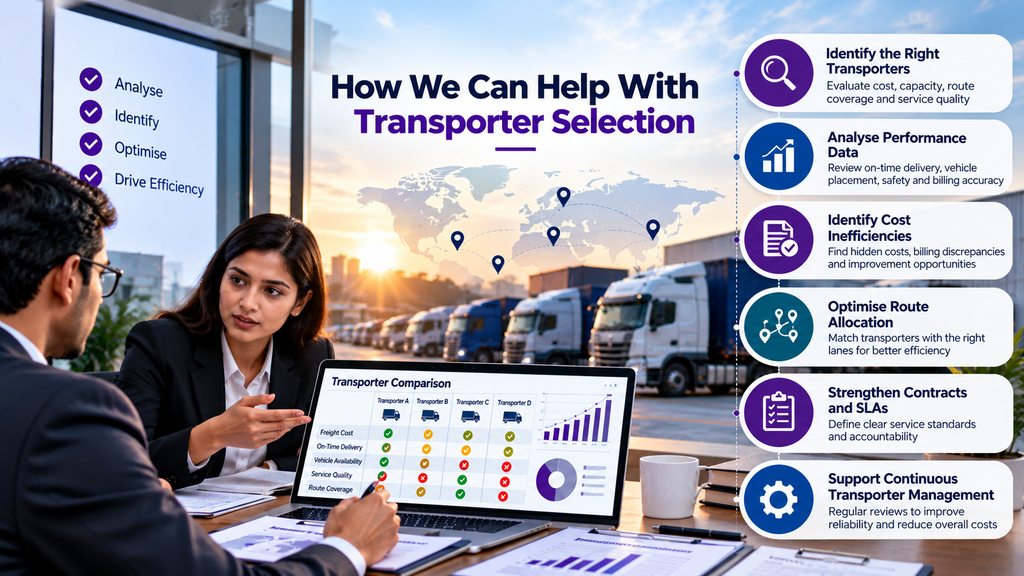
    How Audex Can Help With Transporter Selection

    Effective transporter selection requires a clear understanding of transportation costs, operational requirements and service performance.

    Audex helps businesses evaluate logistics and transportation operations by examining areas such as freight expenditure, transporter performance, vehicle utilisation, transportation planning and operational efficiency.

    A structured transportation audit can help identify:

    • Opportunities to improve transporter selection
    • Gaps in transporter performance monitoring
    • Freight cost inefficiencies
    • Vehicle utilisation challenges
    • Route allocation issues
    • Billing discrepancies
    • Opportunities to strengthen transportation management

    By examining transportation operations beyond individual freight quotations, businesses can gain better visibility into the factors influencing their overall transportation expenditure.

    The objective is to support informed decisions that balance cost efficiency, service reliability and operational requirements.

    Conclusion

    Transporter selection is more than choosing a logistics partner offering the lowest freight rate.

    It requires a comprehensive evaluation of pricing, route coverage, vehicle capacity, delivery reliability, service standards and historical performance.

    By establishing clear evaluation criteria, monitoring transporter KPIs, reviewing contractual compliance and using operational data, businesses can build a more structured approach to transportation management.

    The right transporter is not simply the one who quotes the lowest rate. It is the one who consistently meets business requirements while supporting cost efficiency and reliable operations.

     Choose Transporters Based on Performance, Not Just Price.

    Understanding your transportation network is the first step towards better transporter selection and improved logistics efficiency.

    Explore Audex transportation and supply chain audit solutions to identify opportunities for stronger transporter management and cost optimisation.

  • Transportation Cost Optimisation: 7 Powerful Ways to Reduce Costly Freight Expenses

    Transportation Cost Optimisation: 7 Powerful Ways to Reduce Costly Freight Expenses

    Transportation costs can quietly become one of the largest areas of avoidable business expenditure. Freight rates are only one part of the equation. Vehicle utilisation, route planning, transporter performance, delays, emergency shipments, billing errors and inefficient networks can all increase the actual cost of moving goods.

    This is where Transportation Cost Optimisation becomes important.

    Transportation Cost Optimisation is the process of analysing how goods move, how transporters are selected, how vehicles and routes are utilised, and where unnecessary transportation expenses occur. Instead of simply negotiating lower freight rates, businesses can use data and operational analysis to identify the real causes of transportation cost leakage.

    This article explains seven practical ways to improve Transportation Cost Optimisation, reduce avoidable freight expenses and build a more efficient transportation operation.

    What Is Transportation Cost Optimisation?

    Transportation Cost Optimisation means improving the way goods are transported while balancing cost, service levels, delivery requirements and operational efficiency.

    A transportation network can appear cost-effective on paper while still having significant inefficiencies.

    For example, a business may be paying competitive freight rates but still experience:

    Underutilised vehicles

    Inefficient routes

    Frequent empty kilometres

    Emergency transportation

    Poor transporter performance

    Duplicate or incorrect billing

    Delivery delays

    Excessive dependence on specific transporters

    Poor supplier or distributor clustering

    Inefficient vehicle selection

    Therefore, Transportation Cost Optimisation requires businesses to look beyond the freight rate and examine the complete transportation process.

    Why Transportation Costs Can Become Difficult to Control

    Transportation involves multiple moving parts. A change in order volume, delivery location, vehicle availability or customer requirement can affect transportation expenses.

    Some common reasons transportation costs increase include:

    Poor Vehicle Utilisation

    When vehicles are not loaded efficiently, businesses may pay for transportation capacity that is not being fully used.

    Improving vehicle utilisation can help businesses move more goods without unnecessarily increasing the number of trips.

    Inefficient Route Planning

    Longer routes, unnecessary kilometres and poorly planned delivery sequences can increase fuel consumption, travel time and overall transportation costs.

    Inconsistent Transporter Performance

    A transporter offering a competitive rate may still create additional costs through delays, damages, shortages or poor service reliability.

    Emergency Shipments

    Last-minute transportation requirements can be significantly more expensive than planned shipments. Frequent emergency movements may indicate deeper issues in inventory planning, order management or transportation planning.

    Freight Billing Errors

    Incorrect freight calculations, duplicate bills, incorrect rates and billing discrepancies can result in unnecessary expenditure.

    These factors demonstrate why Transportation Cost Optimisation should consider the complete transportation lifecycle.

    7 Powerful Ways to Improve Transportation Cost Optimisation

    1. Analyse Transportation Cost by Route

    One of the first steps in Transportation Cost Optimisation is understanding how much transportation actually costs across individual routes.

    Instead of looking only at the total monthly freight expenditure, businesses can analyse:

    Freight cost by route

    Cost per kilometre

    Cost per shipment

    Vehicle type

    Shipment volume

    Delivery frequency

    Transporter performance

    Load utilisation

    Route-level analysis can reveal that certain routes consistently generate higher transportation costs than others.

    Businesses can then investigate whether the difference is caused by distance, vehicle utilisation, transporter pricing, shipment frequency or network design.

    This creates a more detailed picture of transportation expenditure and helps management make informed decisions.

    2. Improve Vehicle Utilisation

    Transportation Cost Optimisation

    Vehicle utilisation has a direct impact on transportation efficiency.

    A partially loaded truck can result in businesses paying for unused transportation capacity. Improving load planning can help increase the amount of cargo transported per trip.

    Businesses can review:

    Vehicle capacity

    Shipment weight

    Shipment volume

    Load factor

    Vehicle type

    Pickup and delivery frequency

    Full Truckload and Part Truckload requirements

    For example, if several smaller shipments are travelling toward the same geographic area, consolidating them may reduce the number of trips required.

    Improved vehicle utilisation can therefore contribute significantly to Transportation Cost Optimisation.

    3. Evaluate Transporter Performance

    Transportation cost should not be evaluated using freight rates alone.

    A transporter offering the lowest rate may not necessarily provide the lowest overall transportation cost if the business experiences frequent delays, damages, shortages or service failures.

    Transporter evaluation can include:

    Freight rates

    On-time delivery

    Vehicle availability

    Damage frequency

    Shortage frequency

    Delivery reliability

    Route coverage

    Response time

    Billing accuracy

    Compliance with agreed service levels

    Businesses can use Key Performance Indicators (KPIs) and Service Level Agreements (SLAs) to measure transporter performance consistently.

    This makes transporter management more data-driven and supports better Transportation Cost Optimisation.

    4. Optimise Routes and Transportation Networks

    Transportation efficiency is influenced by more than individual routes.

    The overall transportation network also matters.

    Businesses can review whether:

    Warehouses are positioned efficiently

    Suppliers are geographically clustered

    Distributors are optimally located

    Delivery routes are unnecessarily long

    Multiple shipments can be consolidated

    Milk-run opportunities exist

    Vehicle routes can be redesigned

    Supplier and distributor clustering can help businesses identify opportunities to consolidate transportation movements.

    For businesses operating across multiple locations, network-level analysis can reveal inefficiencies that may not be visible when individual shipments are reviewed separately.

    5. Reduce Avoidable Emergency Shipments

    Emergency transportation can quickly increase freight expenditure.

    Urgent shipments may require premium freight rates, dedicated vehicles or expedited transportation.

    If emergency shipments occur frequently, businesses should investigate the underlying reason.

    Possible causes include:

    Poor demand forecasting

    Delayed production

    Inventory shortages

    Poor shipment planning

    Customer order changes

    Transporter availability issues

    Inefficient warehouse coordination

    Reducing avoidable emergency shipments can improve both Transportation Cost Optimisation and supply chain efficiency.

    The objective is not to eliminate every urgent shipment. Some urgent movements are unavoidable. The objective is to identify recurring patterns and reduce preventable costs.

    6. Strengthen Freight Bill Management

    Transportation expenditure does not end when a shipment reaches its destination.

    Freight bills should also be reviewed for accuracy.

    Businesses can examine:

    Agreed freight rates

    Actual freight charged

    Distance

    Vehicle type

    Additional charges

    Fuel surcharges

    Detention charges

    Duplicate invoices

    Incorrect billing

    Contract compliance

    Effective freight bill validation can help identify discrepancies before they become recurring costs.

    A structured freight audit process can also reduce the amount of internal time spent manually checking transportation invoices.

    This makes freight cost management an important component of Transportation Cost Optimisation.

    7. Use Data to Make Transportation Decisions

    Transportation decisions become more effective when they are based on reliable operational data.

    Businesses can track metrics such as:

    Transportation cost as a percentage of turnover

    Cost per shipment

    Cost per kilometre

    Vehicle utilisation

    On-time delivery

    Transporter performance

    Freight bill discrepancies

    Emergency shipment frequency

    Route performance

    Load utilisation

    Regular reporting can help management identify trends instead of reacting to individual transportation problems.

    Data can also help businesses compare routes, transporters, vehicle types and shipment patterns.

    The result is a more measurable approach to Transportation Cost Optimisation.

    How to Measure Transportation Efficiency

    Transportation Cost Optimisation should be measurable.

    Businesses can establish transportation performance indicators to understand whether operational changes are producing results.

    Transportation Cost

    Measure total transportation expenditure and compare it with shipment volume, revenue or other relevant business metrics.

    Vehicle Utilisation

    Measure how effectively available vehicle capacity is being used.

    Delivery Performance

    Track on-time delivery and identify routes or transporters associated with recurring delays.

    Transporter Performance

    Compare transporter performance against agreed KPIs and SLAs.

    Freight Billing Accuracy

    Monitor billing discrepancies, incorrect rates and duplicate invoices.

    Route Efficiency

    Compare distance, delivery time and transportation cost across major routes.

    These measurements provide a clearer picture of where transportation efficiency can be improved.

    Transportation Cost Optimisation and Freight Cost Management

    Transportation Cost Optimisation and freight cost management are closely connected, but they are not limited to negotiating lower freight rates.

    Freight cost management focuses on understanding and controlling transportation expenditure.

    Transportation Cost Optimisation takes this further by examining how the entire transportation operation can work more efficiently.

    This includes:

    Transportation Cost Optimisation

    Route optimisation

    Vehicle utilisation

    Transporter selection

    Freight bill validation

    Shipment consolidation

    Network optimisation

    Performance monitoring

    A lower freight rate does not automatically mean lower total transportation cost.

    The objective should be to understand the total cost of transportation and the operational factors contributing to it.

    Transportation Cost Optimisation and Supply Chain Efficiency

    Transportation is an important part of the broader supply chain.

    Inefficient transportation can affect inventory, customer service, delivery timelines and overall operational performance.

    For example, recurring transportation delays can result in:

    Production disruptions

    Inventory imbalances

    Missed delivery commitments

    Additional emergency shipments

    Increased operational workload

    Customer dissatisfaction

    Transportation Cost Optimisation can therefore contribute to broader supply chain efficiency when transportation decisions are connected with procurement, warehousing, production and distribution.

    Common Transportation Cost Optimisation Mistakes

    Businesses often focus on transportation costs only when freight expenditure increases.

    This reactive approach can make it difficult to identify the source of recurring inefficiencies.

    Common mistakes include:

    Choosing transporters only based on freight rates

    Ignoring vehicle utilisation

    Reviewing total freight cost without route-level analysis

    Not monitoring transporter KPIs

    Accepting repeated billing discrepancies

    Using emergency transportation too frequently

    Ignoring shipment consolidation opportunities

    Failing to analyse transportation data regularly

    A structured transportation review can help identify these issues before they become significant cost leakages.

    How Audex Can Help With Transportation Cost Optimisation

    Transportation Cost Optimisation requires visibility into the entire transportation process.

    Audex helps businesses evaluate transportation and logistics operations by examining areas such as transportation planning, vehicle utilisation, network efficiency, delivery performance and freight-related processes.

    A transportation audit can help businesses identify:

    Transportation cost leakages

    Inefficient routes

    Vehicle utilisation gaps

    Transporter performance issues

    Freight billing discrepancies

    Network inefficiencies

    Opportunities for better transportation planning

    The objective is not simply to reduce the freight rate.

    The objective is to understand where transportation expenditure is going, identify operational inefficiencies and create opportunities for measurable improvement.

    Conclusion
    Transportation Cost Optimisation

    Transportation Cost Optimisation is not simply about negotiating cheaper freight rates.

    It is about understanding the complete movement of goods and identifying where unnecessary transportation costs are created.

    By analysing routes, improving vehicle utilisation, evaluating transporter performance, optimising networks, reducing avoidable emergency shipments, strengthening freight bill management and using reliable transportation data, businesses can gain greater visibility into their transportation expenditure.

    The first step is understanding where the money is going.

    Before You Reduce Transportation Costs, Understand Them.

    A detailed transportation and logistics audit can help identify the operational gaps, cost leakages and efficiency opportunities within your transportation network.

    Explore Audex transportation and supply chain audit solutions to understand where your transportation costs can be optimised.