Discover how Full Truckload Transportation can improve vehicle utilisation, reduce freight costs, optimise routes and strengthen logistics efficiency.
Full Truckload Transportation: 7 Proven Ways to Maximise Efficiency and Reduce Freight Costs
Full Truckload Transportation plays a significant role in the movement of goods across manufacturing, distribution and supply chain networks. For businesses transporting large volumes of products, selecting the right vehicle and maximising its capacity can directly influence transportation expenditure and delivery performance.
However, simply booking a full truck does not guarantee transportation efficiency.
Poor load planning, inefficient routes, vehicle underutilisation, inconsistent transporter performance and unnecessary empty kilometres can increase the actual cost of transportation.
Full Truckload Transportation efficiency depends on how effectively businesses plan, utilise and manage their available transportation capacity.
By examining shipment patterns, vehicle capacity, route requirements and transporter performance, businesses can identify opportunities to improve load utilisation and control freight expenditure.
This article explores seven practical ways to improve Full Truckload Transportation efficiency and build a more cost-effective logistics operation.
What Is Full Truckload Transportation?
Full Truckload Transportation, commonly known as FTL transportation, refers to a shipping arrangement in which an entire truck is allocated to a shipment or a customer’s transportation requirement.
FTL is generally suitable for businesses transporting large shipment volumes, heavier cargo or goods requiring dedicated vehicle movement.
Unlike Part Truckload transportation, where cargo from multiple shipments may share vehicle capacity, FTL typically provides dedicated transportation for the allocated load.
Businesses use Full Truckload Transportation for:
- Large-volume shipments
- Manufacturing and industrial goods
- Inter-warehouse transfers
- Bulk distribution
- Dedicated customer deliveries
- Time-sensitive shipments
- Goods requiring specific handling arrangements
While FTL offers operational advantages, its cost-effectiveness depends on proper vehicle selection, load planning, route optimisation and transporter management.
Why Full Truckload Transportation Efficiency Matters?
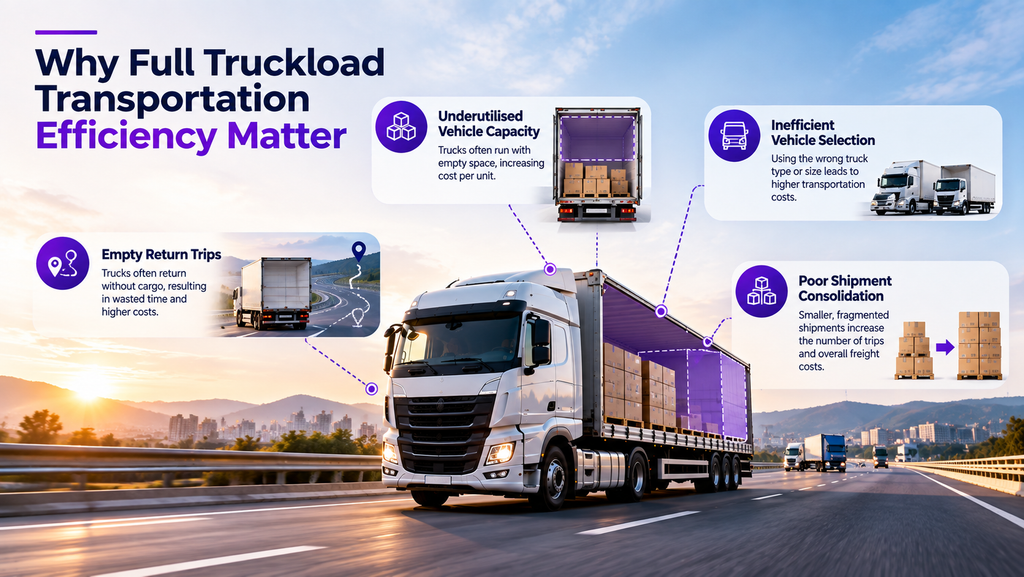
Transportation costs are influenced by several operational factors beyond the freight rate.
A truck that travels with unused capacity may result in businesses paying for transportation resources that are not being fully utilised.
Similarly, poor route planning and inefficient shipment scheduling can increase total transportation expenditure.
Common challenges include:
Underutilised Vehicle Capacity
When the shipment does not use the available vehicle capacity effectively, the cost per unit transported may increase.
Inefficient Vehicle Selection
Selecting a vehicle that is larger or smaller than the shipment requirement can affect freight cost and operational efficiency.
Empty Return Trips
Vehicles returning without cargo may create additional transportation costs, particularly across routes with limited return-load opportunities.
Poor Shipment Consolidation
Multiple shipments moving toward similar destinations may create opportunities for consolidation that businesses fail to identify.
Unplanned Transportation Requirements
Last-minute shipments can lead to premium freight charges and limited vehicle availability.
These challenges demonstrate why Full Truckload Transportation requires continuous planning and performance monitoring.
7 Proven Ways to Improve Full Truckload Transportation Efficiency
1. Maximise Vehicle Capacity Utilisation
Vehicle capacity utilisation is one of the most important factors influencing Full Truckload Transportation efficiency.
Businesses should evaluate whether the selected vehicle is appropriate for the shipment’s weight, volume and handling requirements.
Important considerations include:
- Available vehicle capacity
- Shipment weight
- Cargo volume
- Load dimensions
- Weight restrictions
- Loading arrangements
- Vehicle suitability
- Actual load factor
For example, a shipment may meet the vehicle’s weight limit but leave substantial unused volume. In such cases, businesses can examine whether a different vehicle configuration or shipment consolidation arrangement would improve utilisation.
The objective is to transport the maximum feasible cargo within applicable safety, legal and operational limits.
Better vehicle utilisation can help reduce the transportation cost per unit of cargo moved.
2. Select the Right Vehicle for Every Shipment
Not every shipment requires the same vehicle type.
Selecting vehicles based only on availability or routine practice may result in unnecessary transportation expenditure.
Businesses should consider:
- Shipment weight
- Cargo dimensions
- Loading and unloading requirements
- Delivery location
- Route conditions
- Transit-time expectations
- Vehicle capacity
- Freight pricing structure
A structured vehicle selection process helps businesses match transportation capacity with actual shipment requirements.
This can reduce underutilisation and improve freight cost management without compromising delivery commitments.
3. Consolidate Shipments Wherever Feasible
Shipment consolidation can improve Full Truckload Transportation efficiency by combining compatible cargo movements.
Businesses may identify consolidation opportunities across:
- Similar delivery locations
- Nearby distribution centres
- Supplier clusters
- Scheduled dispatches
- Repeated shipment patterns
- Compatible product categories
For example, two smaller shipments moving toward the same destination may be consolidated into one vehicle if delivery timelines, cargo compatibility and operational requirements permit.
Consolidation should be planned carefully to avoid delays or additional handling costs.
When implemented appropriately, it can help businesses reduce unnecessary trips and improve vehicle utilisation.
4. Optimise Routes and Reduce Empty Kilometres
Transportation cost is influenced by the distance travelled, route conditions and vehicle movement patterns.
Poorly planned routes may increase fuel consumption, transit time and total freight expenditure.
Businesses can review:
- Actual distance travelled
- Planned versus actual routes
- Return-load opportunities
- Delivery sequencing
- Traffic conditions
- Route-specific freight costs
- Vehicle turnaround time
- Repeated empty movements
Identifying suitable return-load opportunities can help improve asset utilisation and reduce the cost associated with empty kilometres.
Route optimisation should consider both outbound and return movements rather than evaluating individual shipments in isolation.
5. Improve Transportation Planning and Scheduling
Unplanned dispatches can create avoidable costs and operational pressure.
Effective transportation planning aligns shipment requirements with vehicle availability, delivery schedules and business priorities.
Businesses can improve planning by:
* Forecasting shipment volumes
- Scheduling dispatches in advance
- Coordinating warehouse readiness
- Aligning vehicle placement with loading schedules
- Consolidating compatible orders
- Monitoring peak-period requirements
- Reducing avoidable last-minute bookings
Better coordination between procurement, production, warehousing and transportation teams can improve vehicle availability and reduce unnecessary waiting time.
6. Monitor Transporter Performance and Freight Rates
A competitive freight rate is only one measure of transporter performance.
Businesses should evaluate whether transporters consistently provide the required vehicle type, meet delivery commitments and comply with agreed commercial terms.
Important performance indicators include:
- Freight rate compliance
- On-time vehicle placement
- On-time delivery
- Vehicle availability
- Transit-time consistency
- Shipment damage frequency
- Billing accuracy
- Response time
- Service-level compliance
Regular performance reviews can help businesses identify transporters who support reliable Full Truckload Transportation operations.
It also provides a basis for reviewing route allocations, contractual terms and opportunities for improvement.
7. Use Transportation Data to Identify Cost Leakage
Data-driven transportation management helps businesses understand where costs are increasing and why.
Rather than reviewing freight expenditure only at the end of the month, businesses can monitor operational indicators regularly.
Useful metrics include:
- Cost per kilometre
- Cost per tonne
- Cost per shipment
- Vehicle utilisation percentage
- Empty kilometre ratio
- On-time delivery percentage
- Vehicle turnaround time
- Freight cost by route
- Freight billing discrepancies
- Actual versus planned transportation expenditure
These measurements help businesses identify recurring inefficiencies and make informed transportation decisions.
A structured review of transportation data can also reveal opportunities that may remain hidden in individual shipment records.
How to Measure Full Truckload Transportation Efficiency?
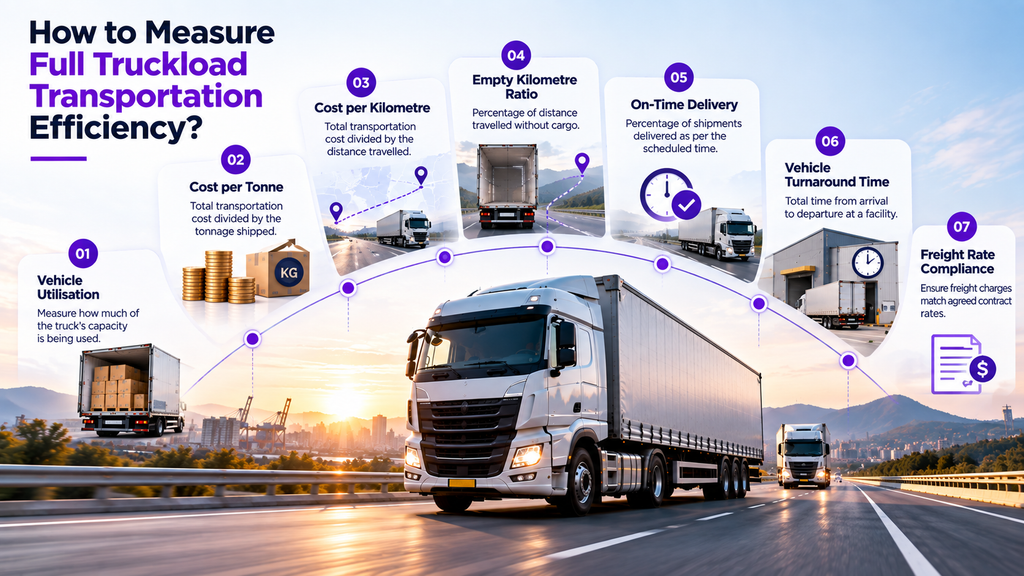
Full Truckload Transportation efficiency should be evaluated using both cost and service performance indicators.
Vehicle Utilisation
Measures how effectively available vehicle capacity is being used.
Cost per Tonne
Helps businesses understand the transportation cost associated with moving a unit of cargo.
Cost per Kilometre
Provides visibility into route-level transportation expenditure.
Empty Kilometre Ratio
Measures the proportion of vehicle distance travelled without cargo.
On-Time Delivery
Tracks whether shipments reach their destinations within committed timelines.
Vehicle Turnaround Time
Measures the time taken for a vehicle to complete its assigned transportation cycle and become available for another movement.
Freight Rate Compliance
Checks whether actual freight charges match agreed contractual rates.
Monitoring these indicators together provides a more complete picture of transportation efficiency than freight expenditure alone.
Full Truckload Transportation and Freight Cost Optimisation
Full Truckload Transportation and freight cost optimisation are closely connected?
However, reducing freight rates without examining vehicle utilisation, route efficiency and shipment planning may not address the underlying causes of transportation expenditure.
A comprehensive approach considers:
- Vehicle selection
- Load consolidation
- Route planning
- Transporter performance
- Return-load opportunities
- Freight bill validation
- Shipment scheduling
- Operational performance
The objective is to reduce avoidable costs while maintaining delivery reliability and service quality.
Common Full Truckload Transportation Mistakes?
Businesses may overlook significant efficiency opportunities when transportation planning is not supported by reliable data.
Common mistakes include:
- Selecting vehicles without evaluating shipment requirements
- Ignoring unused vehicle capacity
- Failing to examine return-load opportunities
- Overlooking shipment consolidation
- Evaluating freight rates without considering total transportation cost
- Not monitoring transporter performance
- Allowing repeated emergency shipments
- Ignoring route-level cost differences
- Failing to measure vehicle turnaround time
Addressing these issues can help businesses establish a more structured approach to Full Truckload Transportation management.
How Audex Can Help With Full Truckload Transportation Efficiency?
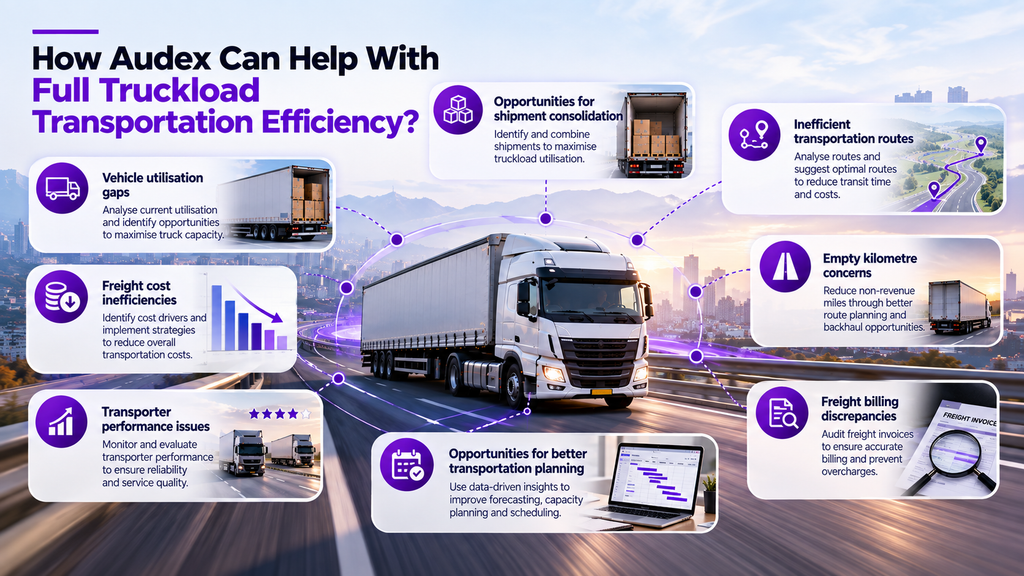
Improving Full Truckload Transportation efficiency requires visibility into freight expenditure, vehicle utilisation, transportation planning and operational performance.
Audex helps businesses evaluate logistics and transportation operations by examining areas such as freight costs, vehicle utilisation, route efficiency, transporter performance and supply chain processes.
A structured transportation audit can help identify:
- Vehicle utilisation gaps
- Freight cost inefficiencies
- Opportunities for shipment consolidation
- Inefficient transportation routes
- Empty kilometre concerns
- Transporter performance issues
- Freight billing discrepancies
- Opportunities for better transportation planning
By analysing transportation operations beyond individual freight quotations, businesses can identify opportunities to improve efficiency and strengthen cost control.
Conclusion ( Audex insights )
Full Truckload Transportation efficiency is not determined by freight rates alone.
It depends on how effectively businesses select vehicles, utilise capacity, consolidate shipments, plan routes and manage transporter performance.
By combining structured transportation planning with regular performance monitoring and reliable operational data, businesses can identify avoidable expenses and improve the efficiency of their transportation networks.
The objective is simple: move more efficiently, utilise available capacity effectively and understand the true cost of every transportation movement.
Before Booking the Next Truck, Understand the Cost of the Current One.
A detailed transportation audit can help reveal vehicle utilisation gaps, route inefficiencies and opportunities for better freight cost management.
Explore Audex transportation and supply chain audit solutions to identify opportunities for improved Full Truckload Transportation efficiency.
Leave a Reply